When the front door opened, the smell of kimchi stew rushed out to meet him — the sourness of fermented kimchi tangled with the savory fat of pork, a smell branded into him since childhood. He took off his shoes and looked around the living room. Everything was so orderly it was hard to believe an old woman lived there alone. Not a single wrinkle marred the sofa; not a speck of dust showed on the glass table. Even the air carried an artificial crispness, as if it had been filtered again and again.
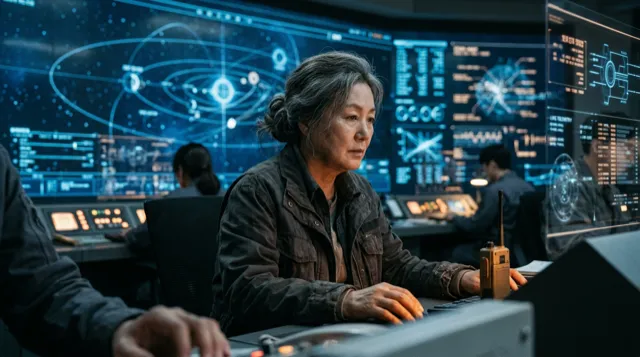
His mother came out from the kitchen, her back held straight in a way that made her seventy years seem beside the point.
"You're here."
Her voice was calm — a tuned voice, almost entirely free of the rise and fall of feeling. He nodded and took off his coat. The table was already set for two: kimchi stew steaming in an earthenware pot, freshly cooked rice, and three or four neat side dishes.
As he sat down at the table, the thin band around his mother's wrist blinked faintly green — the Tuner's status light. A signal that everything was normal. It was the invention that had changed the world ten years ago, his invention. A system that "solved" obesity and metabolic syndrome through an implant wired directly into the brain's neural circuits. The Tuner monitored blood sugar, cholesterol, and blood pressure in real time, keeping appetite and metabolism locked at their optimum. Within five years of its release it had become standard procedure for anyone over forty, and people had called him a genius.
His mother sat down across from him. He picked up his spoon, took a mouthful of the stew, and let it settle on his tongue. Salty, spicy, sour, sweet — the taste he knew by heart. His brain fired off its signal of instant satisfaction. It was the very taste his mother used to make for him on rainy days when he was a boy.
"It's good."
he said. His mother said nothing, only kept moving her spoon — lifting rice, dipping it in the broth, bringing it to her mouth. Her expression never changed as she chewed. She looked like a machine carrying out an order to ingest nutrients. Not once, in the time it took her to empty her bowl, did she frown or smack her lips in pleasure.
"How is it, Mother? Does it suit your taste?"
he asked again. She set down her spoon and wiped the corners of her mouth with a napkin.
"The salt level seems about right, and the nutritional balance looks well managed. The system hasn't raised any warnings."
For a moment he had nothing to say. The system. The Tuner analyzed the nutritional content of a meal and sent a mild warning signal whenever sodium or fat intake ran too high. His mother was judging the meal by data, not by taste.
"No, I mean... is it delicious?"
She looked at him for a moment. Her eyes were clear, but there was no feeling in them at all.
"I don't quite remember what 'delicious' is supposed to feel like anymore. This is just... food that's good for the body. Isn't that enough?"
His heart seemed to drop. The Tuner suppressed harmful appetite — it cut off, at the level of the nerves themselves, any craving for high-calorie, high-fat food. That was its core function. But where, exactly, was the line between that "harmful appetite" and the simple pleasure of eating? Why had he never once asked himself that question?
"They tell me all my numbers are normal. Thanks to you, I stay healthy without ever having to go to the hospital."
His mother's words were meant as praise, but to him they landed like a blade. He forced down the rest of his rice. The kimchi stew he'd loved so much as a child tasted of nothing at all.
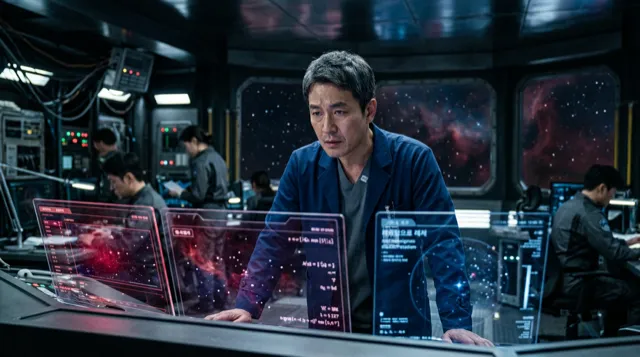
Back home, he went straight to his private lab. He powered on the screen that covered an entire wall and raised the security clearance to its highest level. Then he entered his mother's Tuner ID. The name "Yeonhui" appeared, and with it ten years of her biometric data unfolded in graphs. Every line was perfect. Blood pressure, blood sugar, triglycerides — not once had any of them strayed outside the textbook range of normal. A life in which the very "possibility" of illness had been erased.
He dug deeper into the log files. Neural activity data — the micro-signals the Tuner sent to the limbic system, and the record of their feedback. He found the logs from the time his mother had been eating dinner and zoomed in.
A three-dimensional map of neuron activity rose on the screen. The flow of signals from the moment the kimchi stew's flavor molecules struck her tongue's taste buds, from the moment her olfactory epithelium caught the scent. The signals raced toward the amygdala and the nucleus accumbens — the regions in charge of pleasure and reward. But just before they arrived, the Tuner intervened. A faint reverse-voltage pulse went out and suppressed the activation of her dopamine receptors. [WARNING: Excessive stimulation. Based on sodium/capsaicin levels. Executing reward-circuit stabilization.]
The system was working exactly as intended. It classified the sensation of "deliciousness" as a potential health risk and blocked it before it could form. It wasn't a bug. It was a designed feature. He was forced to confront the fact that the algorithm he himself had designed had stolen from his mother one of the most basic pleasures in the world. All in the name of health.
He searched through his call records and found an old number.
It rang four times before anyone picked up. Faintly, through the receiver, he could hear loud music.
"Who is this."
The voice was sharp, guarded. It belonged to Jisoo, the colleague who had walked out of the company five years ago, calling the technology "inhumane."
"It's me. Minjun."
A silence fell. The music grew faint, as if Jisoo had moved to another room.
"How did you get this number?"
"I need to ask you something about the Tuner's neural suppression algorithm."
"After ten years, now you ask? I cut ties with your technology a long time ago."
There was a chill in Jisoo's voice.
"The threshold value for the positive reward circuit. The default we set... was it too high?"
"Too high? Ha."
Jisoo let out a short, scornful laugh.
"You still don't get what the real problem is. It was never about whether the value's too high or too low, Minjun. The whole idea of controlling it in the first place — that's what's wrong. You didn't cure the world. You anesthetized it. Hunger, craving, even the joy of satisfying them — all of it. People aren't eating delicious food anymore. They're just injecting precisely calibrated fuel."
"My mother... nothing tastes like anything to her anymore."
His voice trembled, just slightly. On the other end of the line came a long sigh.
"I knew it. So your mother's trapped in your perfect system too, in the end."
"Isn't there a way? Some way... to disable the suppression, even temporarily."
"Officially, there isn't one. You made sure of that yourself. Switching off the Tuner counts as the same class of medical act as pulling a life-support line. So — nothing, except illegal."
"Illegal?"
"Every system of control breeds its own resistance, you know. People want to feel it again — real hunger, the pleasure of eating like you mean it. There's a place where people like that gather. Technicians who sell 'jamming' rigs, or roll you back to an old firmware build. Of course, if you get caught, that's the end of your career."
Jisu read out an address. Some abandoned industrial block in the old downtown.
"Never say my name. And remember — once you wake from the anesthesia, going back under can be a lot more painful than staying asleep in the first place."
The call ended. He sat there for a long while, staring blankly at the data on the screen. Perfectly stable green graphs. Those lines now looked to him like the bars of some enormous cell.
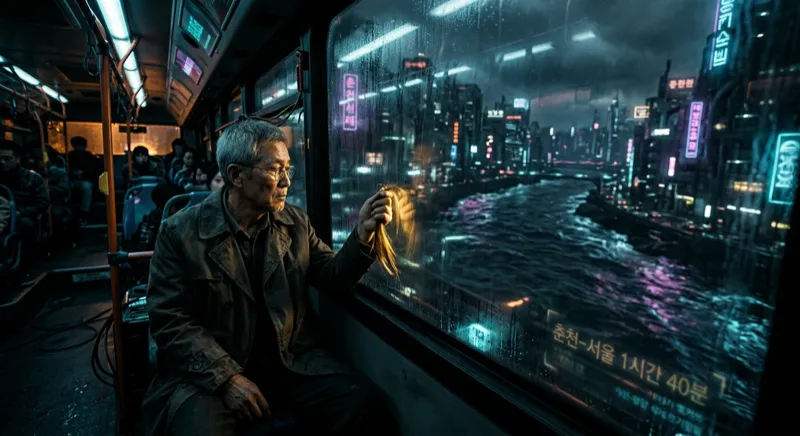
The next evening, he stood before the address Jisu had given him. On the rain-slicked asphalt, the shadow of the old building stretched out long. A sign reading GEUMSEONG MACHINE WORKS hung precariously, its paint stripped away by weather. Through the gap in the door leaked an unidentifiable smell of oil, and beneath it, faint but unmistakable, the smell of food. Garlic and chili oil, sizzling hot — a smell sharp, provocative, and utterly unregulated. He swallowed hard. He knew that the moment he opened that rusted iron door, a crack would open in his perfect world. He hesitated, then took hold of the cold, damp handle.
The rusted hinge screamed as it swung. The air inside had an entirely different density and warmth from the air outside. A blast of heat hit him along with the thick smell of scallion oil, an acrid trace of something scorching, and the smell of human sweat, all tangled together, stabbing into his lungs. It was the chaotic, unrefined smell of things that were alive. As his eyes adjusted to the dark, the interior revealed itself. Shelves were piled high with machine parts whose purpose he couldn't guess, and on the floor, cables lay coiled like snakes. On a workbench sat several disassembled Tuners, their innards laid bare.
At the very back, under a single red incandescent bulb, someone was there. An old man in an oil-stained work coat. He pushed his welding goggles up onto his forehead and looked at Minjun. Deep furrows and a sharp gaze hinted at the weight of his years.
"This isn't a place just anyone walks into."
The old man's voice was hoarse and rough, threaded with something metallic. Minjun looked around. At a small table in the corner, two men sat wolfing down steaming bowls of noodles. The slurp of noodles being sucked in, the smacking sound of broth being drunk down, filled the space. One man ate so fast he choked and broke into a violent coughing fit. Minjun couldn't remember the last time he'd heard sounds like that. In the tuned world, eating was a quiet, elegant act. Noise that raw was taken as evidence of rudeness — or of desire gone uncontrolled.
"Jisu sent me."
When Minjun spoke, the old man's eyebrows twitched. He set down the tool in his hand and stepped closer to Minjun. Up close, black grease was worked deep beneath his fingernails. The old man looked Minjun up and down—the well-fitted coat, the expensive watch, and above all, the alien cleanliness that clung to him. The old man snorted.
"Jisu sent you all the way here? That fussy kid? Sent someone like you?"
He put particular weight on the words "someone like you."
"And what, pray tell, brings the great inventor who tuned the whole world down into a sewer like this."
Minjun was startled that the man already knew who he was, but he didn't let it show.
"It's about my mother's… Tuner. I'd like to temporarily suppress a specific function."
"A specific function. You mean the 'excessive appetite suppression' function."
The old man's sneer didn't waver.
"The one you people dress up as healthy living. From where we're standing, it's just castration of the senses."
He jerked his chin toward the table.
"Those fellows over there—when they first got fitted with a Tuner, they looked just as spotless as you. Then one day it hit them. How empty a life without hunger really is. How terrible it is to sit in front of good food and feel nothing at all. Your system didn't cure the disease. It just switched off the warning light called hunger. The engine's falling apart and the driver never finds out."
The old man went back to his workbench and pulled out a cigarette. He lit it with a battered lighter, and acrid smoke curled up. Quitting smoking, too, was a standard recommendation of the Tuner. Cutting off nicotine dependence at the root was easy work for it.
"My mother… I think she's forgotten how to smile. Every time she eats."
Even to Minjun's own ears, his voice sounded pitiful. The old man said nothing, only let out a long stream of smoke. The sharp edge in his eyes softened, just barely.
"You know the biggest mistake a child makes with a parent? Forcing on them what you believe is right. You wanted to give your mother health as a gift. Only now, it seems, have you realized what it cost her in return."
The old man opened a drawer and pulled out a palm-sized device, crude circuit boards crusted all over it.
"A jammer. It scrambles the neural suppression signals the Tuner sends to the brain. Keep it nearby, and for an hour or two you can slip out from under the system's watch. All the senses you'd forgotten will come flooding back at once."
Minjun's eyes lit up. This was what he'd come for. He reached out his hand, and the old man pulled the device back.
"But I'm warning you, this thing is as good as a drug."
The old man's voice dropped low.
"It's like setting a feast in front of someone who's been starving for years. Most people lose their heads and gorge themselves. Some go chasing after spice hot enough to numb the tongue, others crave food greasy enough to clog a vein. The brain can't handle a desire that's been held back for so long, all breaking loose at once. Your mother's not young anymore… can she withstand a shock like that?"
His words dropped a block of ice straight into Minjun's chest. He pictured his mother eating with that flavorless, vacant expression. What if that emptiness in her eyes filled instead with an appetite she couldn't control? What if she came to resent the son who'd given her back her health? Jisu's warning echoed in his ears again: Once you wake from anesthesia, falling back asleep can be far more painful.
"And... nothing in this world comes free." The old man went on. "You especially, I'll have to charge a steep price."
"How much do you want."
"Money's no use to me." The old man pointed at the disassembled Tuner on his workbench. "The latest security protocol. I've been looking for a way around it, and it's proving none too easy. It'd go a lot smoother with the creator's own hand lending a help. I want you to open a small back door in the heart of your system."
Minjun's whole body went rigid. This was more than mere illegality — it was betrayal. He was being asked to tear down, with his own hands, the security of the world he himself had built. Millions, tens of millions of people's data could be exposed to risk. To restore one woman's lost sense of taste, he would have to hand over a key that threatened everything he'd built.
The old man did not press for an answer. He simply watched Minjun through the cigarette smoke. That gaze seemed to ask, which weighs more — the perfect world you built, or your guilt? Minjun's eyes moved back and forth between the cold, crude jammer and, beyond it, the men hunched over their noodle bowls, faces buried, eating as though ravenous. Cold sweat slicked his palms. Whichever choice he made, he sensed there would be no returning to the world he'd known before.
The silence was brief, but its weight bore down on Minjun's shoulders. On one side, his mother's empty eyes; on the other, the vast, perfect system he himself had created. He'd believed that system was a cure, but as Jisu had said, it was only anesthesia — a life without pain, but a life without joy either. He could look away no longer. If he could reclaim even once his mother's lost time, that hollow, joyless eating.
"I'll tell you."
He stepped up to the battered keyboard on the old man's workbench and began typing in the code with trembling fingers. With every line he wrote, it felt as though he were carving a crack into the world he'd spent 10 years building. This was no simple password. It was a secret passage leading to the deepest part of the system, down to something like the very veins of its neural network. When he pressed the final Enter key, an intricate system schematic unfurled across the old man's worn monitor. The old man nodded, looking satisfied, and without a word pressed the jammer into Minjun's hand.
The cold touch of the metal sharpened his guilt all the more. Forgetting even to bow on his way out, he fled the workshop as though pursued. Outside, darkness had already settled thick over everything. The rain had thickened, and the city's neon signs bled across the wet pavement. The jammer in his hand felt like a foreign object, something set against the very order of this world.
When he opened the front door of his mother's home, he could smell nothing at all. The ventilation system worked perfectly, as always — clean, sterile, antiseptic. His mother sat on the sofa watching a holographic newscast. Minjun took off his coat and sat down across from her. Then he took the jammer from his pocket and set it on the glass table.
"What's this?"
His mother's gaze shifted to the unfamiliar object. Her voice was calm, still tuned to its even pitch. Minjun had no idea how to explain. How could he put into words his own arrogance, his own mistake — everything it had stolen from her?
"I... I was wrong."
His voice came out cracked.
"I only thought about your health. I believed that living long and healthy was everything. But it wasn't. I... I stole your time. The pleasure of eating kimchi jjigae, the taste of a rainy day... I let the machine I built take it all away."
He pushed the jammer toward her.
"This is a device that stops the machine, just for a moment. Only briefly... but it lets you feel everything the way you used to. It could be dangerous, though. All those sensations you've forgotten for so long, flooding back at once... it might be hard on you."
For the first time, he gave his mother the choice. Not a command, but a request for permission.
"Mother. Don't you... want to taste it again?"
His mother looked back and forth between her son's face and the crude device on the table. In her clear, empty eyes, a faint ripple stirred for the first time in a very long while. Minjun couldn't tell what emotion it was. Instead of answering, she slowly reached out, her fingers moving toward the jammer. In that slow motion seemed to rest the weight of countless years.
Minjun went into the kitchen and cooked the kimchi jjigae again. The same ingredients, the same order as yesterday, but his heart was entirely different. The sound of the stew bubbling seemed to beat like a heart. He carried the earthenware pot carefully to the table. His mother was already seated. The jammer lay right beside her hand.
When Minjun sat down across from her, his mother reached for the jammer's small switch. With a soft click, a red light flickered faintly to life on the device. For a moment, nothing seemed to happen. But Minjun could tell. The artificial freshness that had ruled this space vanished, and the spicy, sour smell of the kimchi jjigae pressed into his nose, far more dense and thick than before. The very particles of the air seemed to come alive.
The green light of the Tuner wrapped around his mother's wrist flickered, then went out. Control had been lost.
Slowly, his mother lifted her spoon. For the first time in ten years, her hand trembled, faintly. She scooped up a spoonful of the red broth steaming from the earthenware pot. The brief moment it took to bring the spoon to her mouth felt like an eternity.
The instant the broth touched her tongue, his mother's eyes went wide. It was as if some floodgate of taste, long sealed shut, had burst open all at once. Salty, spicy, sour, sweet, savory — every sensation slammed into her mind at once. Neurons long suppressed woke up screaming. The frozen muscles of her face trembled as if in spasm. She sat frozen, spoon still in hand. She could only blink. The old man's warning had become reality. That storm of sensation was no simple pleasure. It was a confusion closer to pain.
Minjun held his breath, watching his mother. He was afraid he might have woken a monster — afraid he'd made some mistake there was no taking back.
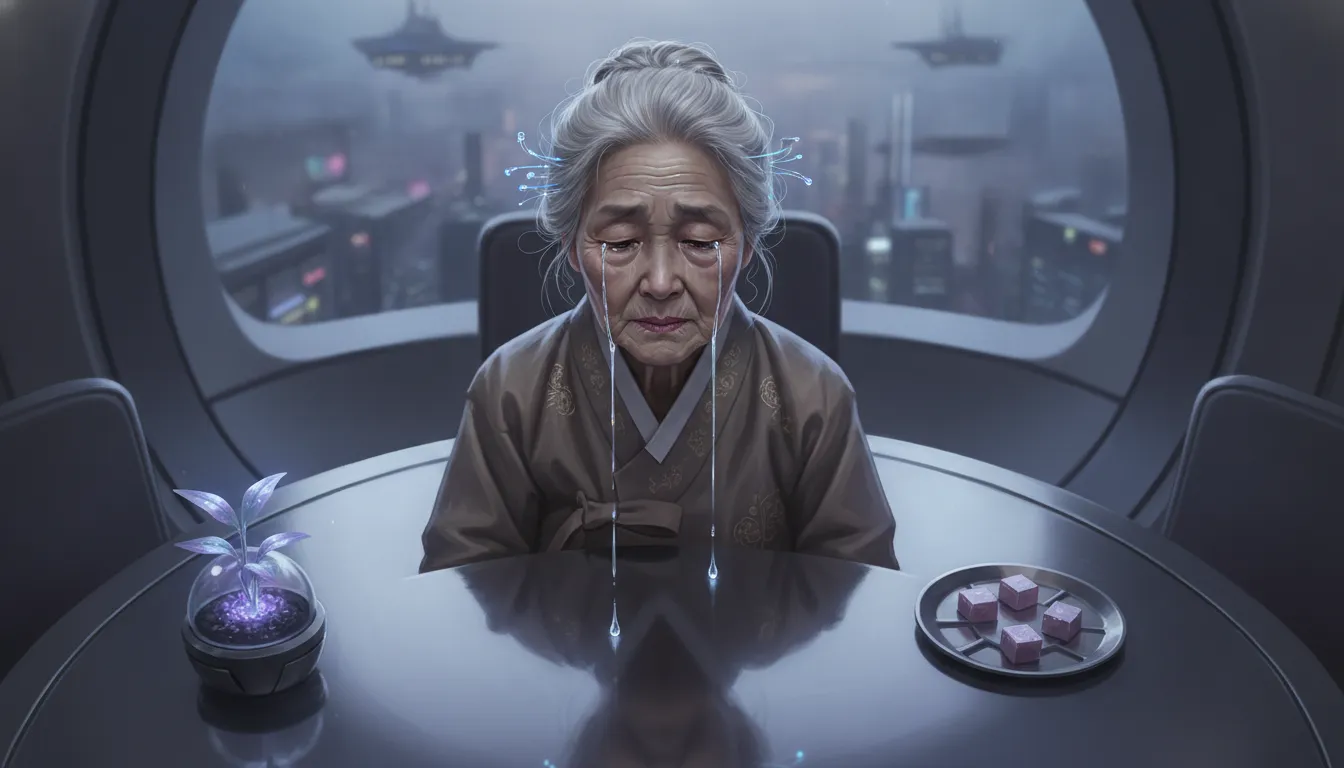
Then, from his mother's clear eyes, a single tear spilled down. Then another. The tears traced down her wrinkled cheeks and hung trembling from her chin. She was crying. Without a sound, her expression barely changing, she simply let the tears fall, endlessly. They were not tears of sorrow, nor of joy. They were a vast ache — her whole body reliving the time she'd lost, the forgotten feeling of being alive.
With a trembling hand, his mother moved her spoon again and lifted a mouthful of rice. She dipped it deep into the stew. She brought it to her mouth and began to chew, slowly, so slowly. Her shoulders shook, faintly. Above the steaming broth, a single clear drop of salt fell, rippling the surface.