The last drop fell from the faucet. With a dry, choking gasp, the pump's faint vibration stopped. The bathtub was filled about a third of the way. Seojin knelt at its edge, watching. The surface of the water trembled very slowly, then stilled. Eight o'clock in the morning, exactly. Today's water supply had ended.
She stood and checked the two plastic buckets hanging on the bathroom wall. One was full; the other, half empty. This was what she had to make last until five the next morning — dishes, washing up, drinking water. She lifted the pitcher she'd filled the night before and poured a glass. The water had passed through a filter, but it carried a faint smell of earth. A familiar smell.
Outside the window, everything was already shrouded in a haze of dust. Ten years had passed since the Integrated Government's climate control system was advertised as perfectly blocking fine particulate matter over the capital region skies, yet every day fine sand still gathered on the windowsill. Seojin pulled out a wet wipe and ran it along the sill. A single pass, and the wipe had already turned gray. Instead of throwing it away, she would let it dry and use it later to wipe the floor. In a world where water had grown scarce, people had learned to use everything twice, three times over.
She changed her clothes and stepped out into the hallway, already bustling in the early morning. Neighbors moved about with their own water containers, headed to line up at the shared water station at the center of the apartment complex. Even after the daily cutoff, 100 liters per household were rationed out as emergency supply, and the line for it usually ran past two hours. Seojin walked past them toward the underground parking garage. She didn't need to stand in line — officials of the Integrated Government's central ministries were allotted an extra 500 liters of water a month. That fact brought her, at times, relief, and at times, a quiet burden of guilt.
As she drove onto the inner ring road, the scenery changed. Along both sides of the road, the glass domes of smart irrigation farms caught the morning light and gleamed — plant factories engineered to wring maximum yield from a minimum of water. The crops growing inside would be given water cleaner than what Seojin drank. As the car's autonomous system eased smoothly through a lane change, she skimmed the news headlines scrolling across the windshield display. 'Drought in Southwestern Region Passes 400 Days, Drinking Water Rations Cut Further.' 'Ministry of Water Resources Suspends Operations at Desalination Plant No. 4 Following Breakdown.' There was no good news.
Twenty minutes later, the car slid into the underground garage of the Integrated Government complex in Gwanghwamun. Her office was on the 17th floor, in the Policy Coordination Office of the Ministry of Extraterrestrial Resources Development. Stepping off the elevator, she was met by cool, dry air — humidity and temperature perfectly controlled, a space entirely untouched by the thirst of the world outside.
Two kinds of reports sat on her desk. On the left, a thick bundle of documents sent the night before by the Ministry of Water Resources, titled 'Request for Budget Review: Metropolitan Water Supply Aging Pipe Replacement Project.' On the right, a thin, crisp brochure titled 'Ares-7 Deep Space Telescope Project Phase 3 Final Budget Approval Request.' On the brochure's cover was a computer-rendered image of a blue-tinted alien planet.
Seojin sat down in her chair and picked up the brochure on the right first. The Ares-7 Project. Humanity's farthest-reaching eye. The project had detected traces of water molecules in the atmospheric spectrum of Xylos, an alien planet orbiting the star TYC 392-1786-1 in the outer reaches of the Andromeda Galaxy, 2.4 million light-years from Earth. She flipped the brochure open, and there was the very graph she'd seen at last week's press briefing. A curve that ran almost flat, save for one tiny needle-like spike. The water vapor absorption spectrum. Evidence that water existed millions of light-years away.
What she had to sign was the budget to 'confirm' that evidence. A plan to triple the telescope's output and sustain observation for ten years, to determine whether Xylos truly had liquid water — an ocean. The budget required for that plan was twelve times the amount needed to replace the aging water pipes on her left.
There was a knock, and the door opened.
"Director, Dr. Park Gi-hyeon is here."
Seojin nodded. A moment later, a gray-streaked-haired man came practically bursting into the office. He was the project lead of Ares-7.
"Good morning, Director. Did you look over the materials I sent yesterday?"
Park Gi-hyeon's voice was, as always, brimming with enthusiasm. He came up to Seojin's desk and switched on the data pad in his hand. Complex equations and simulation footage filled the screen.
"We've refined the atmospheric modeling for Xylos. Even with the data we have now, the probability of liquid water existing on the planet's surface stands at 72 percent. Seventy-two percent! This is... this is like Columbus, right before he discovered the New World, being certain there was land beyond the western sea."
Seojin looked back and forth between his face and the screen, expressionless.
"Doctor, please sit."
At her calm voice, Park Gi-hyeon paused for a moment and sat down in the chair across from her. He leaned forward, as if he had far too much to say.
"All that's left is the final approval. One signature from you, Director, and humanity will have a new ocean. An ocean beyond Earth! You know what that would mean, don't you?"
"I know."
Seojin answered curtly. Her gaze wasn't on Park Gi-hyeon's data pad, but on the water pipe replacement project report to the left of her desk.
"Have you, by any chance, calculated how many of our city's aging water mains this same budget could replace?"
The smile vanished from Park Gi-hyeon's face. He looked as though he hadn't expected the question at all.
"What? That's... isn't that the Ministry of Water Resources' jurisdiction?"
"Seoul's current leakage rate is 17 percent. Pipes over fifty years old are bursting. That means a fifth of the water we send out is vanishing into the ground. According to this report, just half of Ares-7 Phase 3's budget would be enough to replace the main pipelines across all of Seoul. It would bring the leakage rate down to 3 percent."
Park Gi-hyeon was left momentarily speechless. He frowned and spoke.
"Director, this isn't some matter of water pipes. This is an investment in the future of our species. Everyone knows Earth's water will run dry someday. We have to find an alternative. Xylos isn't just a planet—it's a possibility, the next home for humanity. It would be the greatest legacy we could leave our children."
"Those children are short on water to drink today, Doctor."
Seojin's voice was quiet, but it cut heavily through the air of the office. She rose from her seat and walked to the window. Below, seventeen floors down, a haze of dust hung thick over the city.
"Last night there was a protest in Gwanghwamun Square demanding longer water rationing hours. 2,000 people gathered, and 17 were carried away with symptoms of dehydration. My neighbors line up before dawn to catch water that gets cut off by eight in the morning. And here I am, about to sign off on a single sheet of paper committing ten years of their water budget to searching for an ocean 2.4 million light-years away."
She turned and looked at Park Gi-hyeon. His face had flushed red.
"That's short-sighted! Great discoveries have always been built on sacrifices made in the present! If we don't plant the seed now, our children's generation will have no fruit at all to harvest."
"And what if the ground you'd plant that seed in is already dying of thirst?"
Silence fell. Park Gi-hyeon could no longer find words; his lips only moved without sound. Seojin returned to her seat. She laid the Ares-7 brochure and the Ministry of Water Resources report side by side. One page was a dream of the cosmos printed on glossy stock; the other was the city's reality printed on rough recycled paper.
"The decision has to be made by this afternoon."
Park Gi-hyeon barely managed to speak. The passion from before had drained out of his voice.
"I know. You may go now."
Park Gi-hyeon rose to his feet. Heading for the door, he paused and turned back.
"Director. That spectral line... it isn't just data. It's hope."
After he left, only stillness remained in the office. Seojin ran her finger along the thin spectral graph printed on the brochure. Hope. She picked up the cup on her desk and drank what water was left. A faint smell of earth lingered again in her mouth.
It was the smell of soil, the wellspring of life—but now it felt like an omen of the end. She closed her eyes for a moment. In her mind, two scales hung in taut opposition. On one side lay an ocean 2.4 million light-years away; on the other, a water pipe that might burst as soon as tomorrow. Both were matters bound directly to humanity's survival, but on wildly different timescales.
A low tone sounded from the intercom on her desk. She checked the caller: it read "Choi Min-jun, Team Leader, Infrastructure Management Team, Ministry of Water Resources." By protocol, a team leader from another ministry should never contact her directly. It was a sign that something was going wrong.
"Put him through."
She spoke curtly, and from the speaker came a burst of static followed by an urgent voice.
"Director, I know this is out of line, but I have something urgent to report. Could you spare five minutes?"
Seojin hesitated for a moment. A call from the Ministry of Water Resources, right after her meeting with Dr. Park Gi-hyeon. That couldn't be a coincidence. She looked down at the two reports on her desk.
"Send him up."
Before five minutes had passed, the office door opened and a man walked in. Team Leader Choi Min-jun seemed, in every respect, the polar opposite of Dr. Park Gi-hyeon. Lean-framed, his face weathered by sun and dust, a work smartwatch strapped beneath the sleeve of an old, ill-fitting suit. He seemed to have dragged a fistful of the outside world's dry air into this immaculately controlled space.
"Thank you for agreeing to see me on such short notice, Director."
He bowed at the waist, and the smell of sweat and dust wafted off him. Seojin gestured toward a chair.
"Let's keep this brief, Team Leader Choi. We're both busy people, as you know."
Choi Min-jun nodded, his face set, and pulled a data pad from inside his jacket. When he lit up the screen, a map of the water mains appeared—one riddled with red warning markers far more complex than anything in the report sitting on Seojin's desk.
"The report you're reviewing was compiled from last quarter's data. The situation is far more serious than that."
He zoomed in on one section of the map. South of the Han River, the No. 1 trunk line running to the Songpa intake station. Certain points along the pipe on the screen were blinking like flares.
"This is acoustic sensor data, along with internal pressure readings. As of 11 p.m. last night, they crossed the critical threshold. It means micro-fractures are forming simultaneously throughout the line. According to our simulations, at this rate, it won't hold for a week. If the No. 1 trunk line ruptures—"
Choi Min-jun couldn't finish the sentence; he swallowed hard. Seojin finished it for him.
"Gangnam, Seocho, Songpa, Gangdong. Water supply would be cut off across the entire southeastern quarter of Seoul."
"It's more than a cutoff, Director. Restoration would take at least three months. That's far beyond what any emergency water network could sustain. Four million people would be left in complete isolation from drinking water. Last night's protest at Gwanghwamun—it'll look like child's play by comparison."
The cool air in the office seemed to evaporate all at once. Seojin sank back deep into her chair. This wasn't a matter of administrative figures like a 17 percent leak rate. This was a forecast of catastrophe, specifying an exact time and place.
"Why didn't you go through the official reporting channel?"
"Because it would be too late. I calculated the time it would take to bring this forward as a formal agenda item, request emergency funding, and have that funding clear the thresholds of multiple ministries before finally reaching our hands. By the time that process wrapped up, we'd already be standing dumbstruck in front of a ruptured main."
Choi Min-jun's gaze drifted to the brochure for the Ares-7 project lying on Seojin's desk. Desperation and a flicker of contempt crossed his eyes at once.
“I've heard there's a budget item sitting there waiting on nothing but the Director's signature. I don't know what that money is for, or how magnificent the work is. Frankly, I don't care. But I know this much: with just a tenth of that budget, we could deploy an emergency reinforcement team right now and head off the worst of it. We could bring the rupture probability down from 80% to 15%.”
He rose from his seat and bowed deeply once more. His back trembled, faintly.
“Please… please look beneath the ground, Director. Not at a sky millions of light-years away, but right beneath the earth we stand on, where people are dying.”
Choi Min-jun left, and the office door closed without a sound. Seojin didn't move for a while. The word “hope,” which Park Gi-hyeon had used, and the word “catastrophe,” which Choi Min-jun had just invoked, tangled together horribly in her mind. She moved back toward the window. Beyond the haze of dust, the great city lay sprawled out, a landscape that looked, for all the world, at peace. But now her eyes could see what wasn't visible — the water pipes coiled beneath the ground like aging blood vessels, wrapped around the city. She thought she could hear, from somewhere inside them, the ticking of a time bomb.
The ticking of the clock's second hand seemed unusually loud. As if she'd made up her mind, she reached out and pulled the approval pad reserved for emergency budgets toward herself from one side of the desk — the funding for the emergency reinforcement team that Team Lead Choi Min-jun had spoken of. It was an overreach that ignored regulation and procedure, but she couldn't turn her back on the thirst of four million people. Just as she was about to press her fingerprint to the pad, the intercom on her desk rang again. This time it was a direct line, bypassing the secretary's office. The caller ID read: Minister's Office.
“Director Seo, it's me.”
Minister Yoon's low, forceful voice came through the speaker. Seojin lifted her hand off the pad and straightened up.
“Yes, Minister.”
“The Ares-7 report — it's come up to you, hasn't it? Dr. Park Gi-hyeon must have stopped by too.”
“I just finished reviewing it.”
“Good. There's a presidential briefing set for 3 p.m. We need news that can give the public some hope. You know how restless public sentiment's been lately. People shouldn't just stare at the ground and sigh — every now and then, they need to look up at the sky too. And that's exactly the job of our ministry.”
There was no room in the Minister's voice for doubt or question. It was a notification, not a discussion. Seojin wet her dry lips.
“Minister, but regarding the metropolitan water supply system…”
“Ah, I saw that report too.”
Minister Yoon cut her off lightly. There was a trace of irritation in his voice.
“Those Ministry of Water Resources people — same song every year. Isn't it practically an annual ritual for them, moaning on as if throwing money at it would solve everything? Director Seo, you need to see the bigger picture. Think about what it'll do for the Integrated Government's standing to make a success of a project that opens up humanity's future, rather than patching up a few water pipes for now. This isn't just about the practical gain of securing extraterrestrial resources — it'll be a symbol that unites and leads the public. Get it signed off by 2 p.m. We need to put together the briefing materials.”
The transmission cut out. A heavy silence settled over the office once more. Seojin's gaze moved between her own hands and the approval pad resting beneath them, holding two opposing futures. Could people really endure the cracked earth beneath their feet just to see the stars above, as Minister Yoon had said? Or was it that they had no choice but to endure it? At her fingertips, the fate of the city trembled faintly.
With the transmission gone, the office felt like it had become a perfect vacuum. Seojin held her breath until the last echo of Minister Yoon's voice had scattered into the air. The big picture. A symbol. Hope. The words circled in her mind. They were so vast and so smooth that there was no room left for things like Team Leader Choi Min-jun's cracked knuckles, or the exhausted faces of the neighbors who used to fill the apartment corridor.
She raised her eyes to the two documents on her desk. A brochure for a blue planet, and a report on yellowed recycled paper. Sky and earth. Future and present. Hope and survival. But this was no longer a choice to be made. The minister's words were an order, and the decision handed down from the very top of this vast bureaucracy had already become an unstoppable current, pushing all the way to her desk.
She did not resist. She could not. All she could do here was not change the direction of the current, but stamp the correct document in accordance with it. That was the true nature of the position of Policy Coordination Office Director at the Ministry of Extraterrestrial Resources Development. Slowly, she reached out and picked up the data pad for approval, lying beside the Ares-7 project brochure.
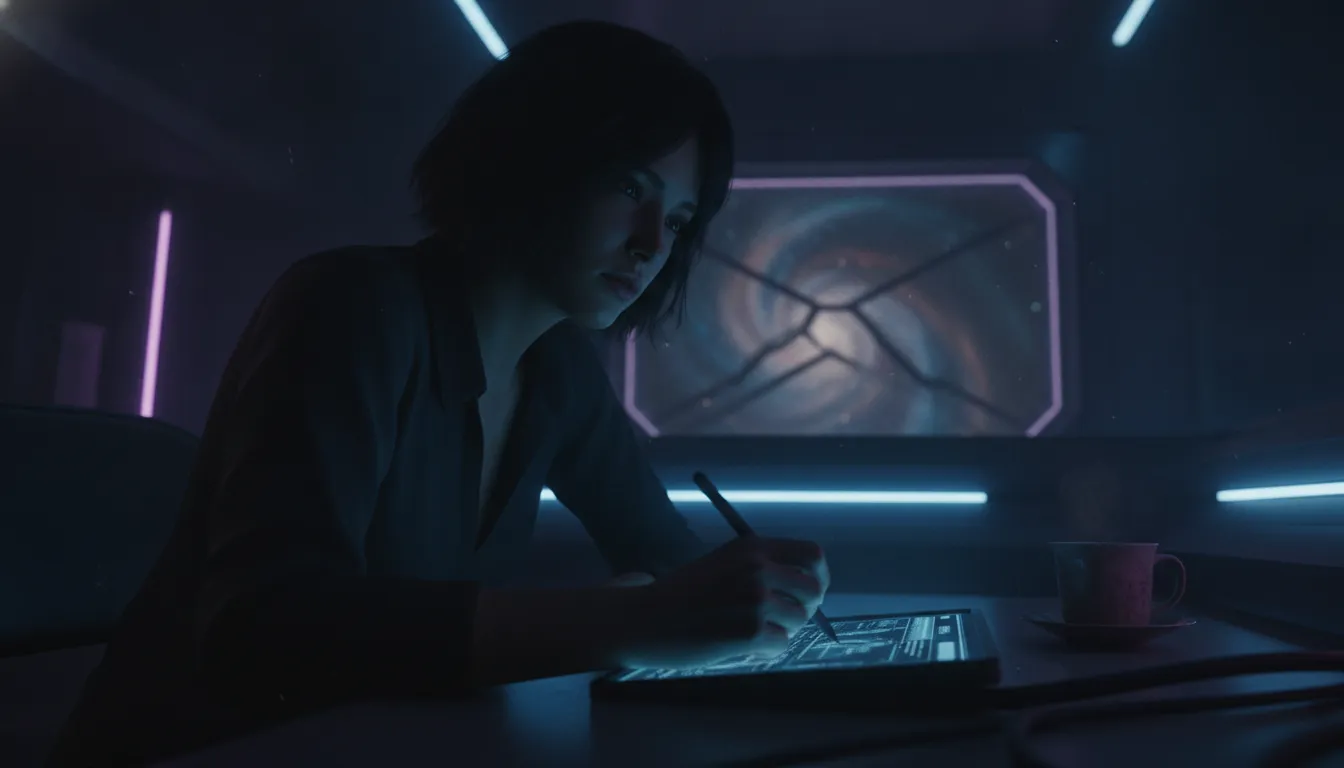
The cold touch of the pad pressed against her palm. When the screen lit up, the words "Ares-7 Deep Space Telescope Project Phase 3 Budget — Final Approval Request" appeared in sharp focus. She lifted the stylus. Just before its tip touched the screen, a brief stillness passed. In that instant, she thought not of an unknown ocean 2.4 million light-years away, but of the faint smell of soil she'd caught last night while pouring water into a cup. The smell of dry, cracked earth. The smell of the place where everything had begun.
She signed. She watched, numbly, as the three characters of her name were etched onto the screen in blue light. The moment she pressed "Approve," the file was transmitted instantly to the Minister's office. The whole thing took less than 30 seconds. She pushed the data pad to the far side of her desk, as though pushing away something tainted. Then she picked up the Ministry of Water Resources report and tossed it into the bottom drawer of the filing cabinet, into the folder marked "Pending." The sound of the steel drawer closing sliced through the silence of the room.
3 p.m. At the appointed hour, the large screen on the office wall switched on, and the President's emergency briefing began. Against the backdrop of a perfectly composed office, the President spoke in a firm, confident voice.
"My fellow citizens, today I wish to speak not of despair, but of hope."
Seojin stared at the screen, her face blank. Behind the President, on the screen, the cover photo of the brochure she had just approved rose up in magnificent splendor — the image of the blue planet, Xylos.
"We have discovered evidence of a new ocean, 2.4 million light-years from Earth. This is not simply a story about a distant star. This is a new future to hand down to our children, and it is the fruit of humanity's great pioneering spirit—"
It was the moment the President's speech was building toward its climax. At the bottom of the screen, a nail-sized red caption blinked into view. '[Emergency Disaster Alert] Main water pipe rupture in the Songpa-gu area of Seoul. Complete water suspension across Gangnam, Seocho, Songpa, and Gangdong districts. Time of restoration unknown.'
The caption lingered for a few seconds before vanishing, but the red letters had already branded themselves onto Seojin's retinas like a mark. On the screen, the President was still smiling, still promising humanity's future. In the cool office, in air whose humidity was kept under perfect control, Seojin suddenly felt a violent thirst.
She rose from her seat and walked to the window. Beyond the hazy veil of dust, the city where the catastrophe had begun lay in silence. Everything looked just as it always did. But deep beneath the ground, invisible, the arteries of this vast city were bursting open. She went back to her desk and picked up the pitcher holding the water left over from that morning. She tilted it toward her cup. Clear water fell in, sending up small ripples. She lifted the cup and slowly, completely, swallowed down the cold water, faintly tinged with the smell of earth.