When the lights dimmed in Room 5 of the funeral home, the woman closed her eyes and drew a breath. On the count of three, the crying had to come. One, two. A sound long pressed down in her throat rose up. Three. Wailing filled the narrow room.
The timing was exact. A few mourners flinched at the sound, shoulders drawing up. Nobody cried like that anymore, not these days. An old man seated beside the chief mourner leaned toward the person next to him.
"That woman—they say she's a gokbi. Do people still do that kind of work?"
"She's hired for it. I heard they pay by the hour."
Without opening her eyes, the woman adjusted the swell of her crying—raising it high, letting it drop, then pushing it up again. In the memorial photo, the face was smiling. A woman who looked to be in her seventies. Cause of death: old age. An ordinary death, an ordinary funeral. The mourners' eyes were dry. Across the hall, in Room 6, another funeral procession was underway around the same hour. That room had no gokbi. It was quiet.
Only one or two funerals in ten called for a gokbi. The funeral company's manager had told Yeo-ok more than once that this line of work wouldn't last much longer. Ever since the Standard Prescription, the mourning period itself had grown shorter. Some funeral processions ran just thirty minutes. The company called that package
the "Simple Course."
The woman's name was Yeo-ok. On the funeral company's roster, she was listed under
"Emotional Proxy."
Her official title was gokbi. A profession said to date back to the Joseon dynasty, still alive today under nothing but a new name. Except now the work wasn't crying in someone else's place—it was filling a place where no one cried at all.
After the funeral procession ended, Yeo-ok was handed an envelope. It was thin. That was what the pay had come to these days. In the waiting room lobby of the funeral company hung a large screen, and on it a young actor stood smiling, a pill resting in his open palm.
"Glimatab—our 22nd spring together, thanks to the Standard Prescription."
The caption rolled by. Then another line followed.
"Now you can say goodbye without the pain. The right to forget—that's what Glimatab gives you."
National prescription rate: 97 percent. Beneath it, in smaller print, another line scrolled past. Alzheimer's incidence rate: 0.03 percent.
Glimatab had originally been a drug for managing obesity and diabetes. Some twenty years ago, reports emerged that people who had taken it long-term showed significantly less neuronal damage. Clinical trials resumed, and five years later the government recommended the Standard Prescription for every citizen over forty. There had been a time when pharmacies everywhere ran out of stock—Yeo-ok knew this only from old news footage. By the year that recommendation was announced, Da-in was already gone.
Yeo-ok took the bus home. Her place was a single room. The window faced the wall of the next building, so she had to keep the light on even during the day. The hum of the refrigerator and the sound of pipes from the floor above were the only background noise. Yeo-ok took off her coat, draped it over a chair, and went to the kitchen.
In the kitchen drawer sat a month's worth of Glimatab. Half of her prescribed dose, to be exact. The other half she kept hidden in the back of the freezer, behind a bag of frozen dumplings. At every checkup at the public health center they checked her medication records, but no one ever went searching through the freezer.
Yeo-ok left the medicine packet unopened on the table. Instead she took the old tape recorder out from the back of the drawer. A thin layer of dust had settled on its surface. She wiped it once with her sleeve and pressed the button. Behind the whir of the tape, a child's voice came through.
"Mom, look at this. My tooth fell out."
A voice from 22 years ago. Da-in's. A seven-year-old, grinning with both front teeth missing. Yeo-ok could draw that face exactly — the slight droop at the corners of her eyebrows, the small mole on her left cheek, even the color of her gums when she smiled.
The first time she started the standard prescription was the spring two years after Da-in was gone. That day too, she lay down under the blanket, ready to walk through the accident from start to finish. The truck's headlights, the wet asphalt, one of Da-in's shoes. She called them up in order. By the time she reached the shoe, her eyes were dry. Yeo-ok threw off the blanket and sat up. She went through it again from the beginning. The truck's headlights, the wet asphalt, one shoe. The second time, her eyes stayed dry too.
That night Yeo-ok emptied the rest of the packet into the toilet. The next day she picked up a new prescription at the hospital, but that was when she started taking only half.
Every night Yeo-ok switched on the recorder. Da-in's voice, the truck's headlights, the wet asphalt, one shoe. Checking the order was the last task of her day. As long as the order held, that day had passed.
The last Tuesday of every month was checkup day at the public health center. Everyone on the standard prescription was required to attend. The nurse pressed the lancet to Yeo-ok's fingertip and said,
"Ma'am, you've been keeping up with your medicine, right?"
"Of course."
"Not a single new Alzheimer's diagnosis in the district all year. They say back in the day, three or four in ten people your age used to come down with it."
Yeo-ok watched the blood well up on her fingertip. A red dot bloomed on the test strip.
"Isn't it something? Nobody forgets anymore."
"I suppose so."
The nurse scrolled the screen, brow tightening.
"Your cognitive score dipped a little this past half-year, though. From 82 to 76. We sometimes see that in people whose adherence is slipping — have you missed any doses lately?"
"No."
The nurse checked the screen once more, then moved on to the next item.
"All right, we'll check again next half-year. Try not to worry."
Leaving the health center, Yeo-ok peeled the bandage off her fingertip. A little blood still welled up. She stared at the mark for a long while.
When she got home, a notification from the funeral brokerage app was waiting on her phone. One new request. Yeo-ok tapped it open. The name on the screen meant nothing to her. Jeong Jae-hyeon. Two days before the burial. The address was a fifteen-minute walk away. Yeo-ok pressed accept.
Three days later, the man came to Yeo-ok's house himself. He looked to be in his mid-thirties, in a suit jacket with no tie. He rang the bell twice at the door, and hesitated with his finger raised before the third ring.
"Um... I got this number through the funeral service."
Yeo-ok looked at him through the half-open door.
"You need a gokbi?"
"Yes. My mother... passed away the day before yesterday."
"When's the burial?"
"The day after tomorrow."
Yeo-ok didn't let him in. She laid out the terms first.
"150,000 won an hour. 300,000 if you want me through the burial. I'll cry like it's real."
"Like it's real."
He repeated the phrase back, as if it sounded strange. Yeo-ok looked at his face again. No swelling under his eyes. The face of someone who hadn't cried.
"Your mother died and you're not crying?"
The man dropped his gaze. He looked at his own feet.
"I should be. It just . . . doesn't come. I started the standard prescription eight years ago. They say on the news everyone's like this now. That three days is enough to sort it out."
"Like a three-day funeral."
"Yes. Exactly that much."
The man's name was Jae-hyun. He stood at the threshold, glancing into the house — an unopened packet of pills on the table, a recorder cord spilling out of a drawer.
"Can I ask something strange?"
"What."
"Crying. Can you still do it? For real, I mean."
Yeo-ok didn't answer. She just opened the door the rest of the way.
"Half the deposit, now."
Jae-hyun pulled out his wallet, still talking.
"Not that I envy you. I'm just curious. When I look at my mother's face, it's like — I don't know — like looking through a window. I know it's sad. I just can't touch it."
Yeo-ok took the money without counting it and slid it into her pocket.
"Stop the medication and you can touch it."
"Isn't that illegal?"
"Not illegal. Just nobody does it."
Jae-hyun asked, putting his wallet away again.
"Why doesn't anyone?"
"Because there's nothing they want back."
Something in that answer made Jae-hyun want to ask more, but he let it go. Instead he held out a slip of paper with the burial time and the funeral hall's address.
On the day of the burial, Yeo-ok arrived ten minutes early. In the memorial photograph, the woman wore a gentle smile. Jae-hyun stood at the door in mourning clothes, his expression unchanged.
Yeo-ok took her seat and closed her eyes. One, two, three. She pushed the sound up from inside her. When the wailing began, a few mourners turned to look. Jae-hyun's shoulders moved, just slightly.
It was time to move the coffin. Yeo-ok walked alongside it, keeping up the wail. The moment she saw the coffin's handle, the sound stopped in her throat. The handle was silver. Twenty-two years ago, Da-in's coffin had carried a handle of the same shape. Yeo-ok tried to recall the season she had buried that coffin in the ground — whether it had been spring or autumn, what color the sky had been that day. The shape of the handle was vivid. The sky was gone.
Yeo-ok's feet stopped. The people behind her nearly collided with her. Jae-hyun caught her by the arm.
"Are you all right?"
Yeo-ok didn't answer. She simply started walking again, pushing the wail back up — but it was a different sound now. The rhythm was off.
On the bus to the burial ground, Jae-hyun took the seat beside her — the back row, a little apart from the other mourners.
"Earlier, when you stopped for a moment."
"I never stopped."
"You did stop."
Yeo-ok looked out the window. The passing scenery layered over her own reflected face.
"The handle looked familiar."
Jae-hyun didn't press further. Instead he looked out the window with her. Each time the bus swayed, their shoulders touched for a moment, then drew apart.
The burial ground was halfway up a low hill. While the workers adjusted the lowering ropes, Yeo-ok readied herself to wail again. One, two. Before she reached three, Jae-hyun asked in a low voice.
"Was she your daughter?"
Yeo-ok's breath caught. Three passed. The wail didn't come.
"What did you say?"
"When you talked about the handle, your face... never mind."
The coffin began to descend into the earth. The ropes loosened slowly. Yeo-ok pushed the sound up from her throat again. This time it came. Late as it was, it came out loud.
While the coffin sank fully into the earth, the workers added three or four more shovelfuls. Jae-hyun didn't move from where he stood, watching Yeo-ok's profile the whole time. Yeo-ok didn't stop wailing. The sound came out loud, but the rhythm was still off. She counted two where she should have counted one, and stopped where she should have counted two. A few mourners exchanged puzzled glances. A funeral home employee slipped over and touched Yeo-ok's elbow.
"Time's up."
Yeo-ok opened her eyes and stopped wailing. Her throat was hoarse. Ordinarily, her voice wouldn't have suffered like this.
After the burial, everyone walked back down the hill. Yeo-ok walked at the very back. The earth underfoot was damp. The sound of clumped dirt clinging to her soles seemed unusually loud. Jae-hyun dropped back to match her pace.
"I'll give you the envelope at the funeral hall."
"There's no rush."
"It's not about the rush. There's something I wanted to ask."
Yeo-ok didn't stop walking.
"You didn't answer that question from before."
"What question."
"Whether she was your daughter."
Yeo-ok looked at a tree beside the mountain path. A winter tree, all its leaves gone. The sky showed through the branches in fragments.
"A gokbi doesn't ask about your story. Crying is the job."
"But what you did back there wasn't crying. That."
"What are you talking about."
"The rhythm was off. I listened to the whole thing, so I know. While I was preparing for my mother's funeral I watched maybe twenty review videos of gokbi. They're all the same, one two three. But just now, it wasn't."
Yeo-ok didn't answer and kept walking. Jae-hyun walked alongside her and went on.
"Actually, calling a gokbi for my mother's funeral today—it wasn't for my mother's sake to begin with."
"Then?"
"It was for mine. I thought if I had someone crying beside me, something might come out of me too. But it didn't. Instead, back there, when you stopped—I saw something then. That was real."
Neither spoke until they reached the parking lot at the foot of the hill. The funeral company's bus was waiting. Yeo-ok said she wouldn't take the bus, that she'd walk back. Jae-hyun came along.
"You should take the bus—you must have come a long way."
"I just want to clear my head."
"Can I walk with you?"
Instead of answering, Yeo-ok started walking. Jae-hyun threw a coat over his mourning clothes and followed.
The two of them walked along the road beneath the low hill. The winter afternoon sun hung low. Jae-hyun spoke again.
"Yeo-ok, why do you only take half?"
Yeo-ok's steps faltered for a moment.
"Take half of what?"
"The medicine. The packet in your drawer—still sealed, never opened. I saw it that day, at your place."
"Why were you looking through someone else's drawer?"
"I wasn't trying to look. It was just there. You were standing right by the door."
Yeo-ok stopped and turned to face Jae-hyun.
"That's none of your business."
"I know. But I've been thinking about it too, lately. What happens if you stop. The news only ever says it's dangerous, never exactly how. Cognitive decline, risk of early-onset dementia—just those words, over and over."
"It is dangerous."
"But you're doing it anyway."
"I—"
Yeo-ok cut herself off. She'd thought there was no need to explain, then thought again. This man had buried his mother today. The face that had said it felt like watching through a window hadn't changed at all.
"I don't have anything left to lose. You're not like that. You have a job, a family."
"My mother's gone now."
"You have other family."
"I have one younger sister. She's just like me. Today was the burial and she never even showed her face. Said she couldn't come because of a posting out of town—I know that's just an excuse. She's watching her own mother's death through a window too."
Wind blew, rattling the dry branches. Yeo-ok started walking again. Jae-hyun matched her pace and asked,
"When you stop taking it, what does it feel like—at first, I mean?"
"Don't ask."
"I'm just curious."
"I said don't ask."
Yeo-ok's voice rose. A passing car slowed for a moment, then drove on. Jae-hyun fell silent.
They walked on in silence for a long while before Yeo-ok spoke first.
"The public health center measures your cognitive score every half-year. If your compliance is low, they assign you a caseworker. Someone comes to your home. After that, it switches to mandatory prescription. You work at a company, right? That gets reported to your employer."
Jae-hyun's face stiffened slightly.
"It goes that far?"
"It's a guideline that changed last year. Medication compliance got folded into the national health management index. It shows up in company group checkup results."
"I didn't know that."
"So don't ask. The more curious you get, the more dangerous it becomes."
Jae-hyun stopped and looked straight at Yeo-ok.
"Then why haven't you been caught yet? You said your score dropped at the last checkup. Wouldn't that put you in line for a caseworker?"
Yeo-ok couldn't answer. She pictured the nurse scrolling through the screen, brow furrowing, and the words: we'll check again next half-year.
"Not yet."
"Not yet."
Jae-hyun repeated it, as if turning it over in his mouth.
"So what happens next half-year?"
Yeo-ok didn't answer, and started walking again. Behind her, Jae-hyun's footsteps followed. Far ahead, a bus stop sign came into view.
Under the bus stop sign, Jae-hyun dug through his coat pocket. He pulled out a crumpled receipt and pressed a few numbers onto the back of it with a ballpoint pen.
"It's my number. In case you get bored while you're walking."
Yeo-ok didn't take it.
"I don't need it."
"Then throw it away. I just wanted to give it to you."
Jae-hyun pushed the paper into Yeo-ok's coat pocket. Their fingertips brushed for a moment. Yeo-ok didn't pull her hand away.
A bus arrived and left again, just like that. Neither of them got on.
"Aren't you getting on?"
"I told you, I'm walking."
"Then I won't get on either."
"Trying to save the fare?"
"No. I just feel like if we part ways now, I won't get to hear what comes next."
Yeo-ok studied him for a long time. The face that had seemed like something seen through a window now looked like a face with the window gone. His eyes were red-rimmed. What hadn't come out all day had finally gathered there. Yeo-ok recognized that look. It was a face she'd met hundreds of times doing gokbi work — the face right before it breaks.
"Cry."
"What?"
"If you want to cry, cry. No one's watching."
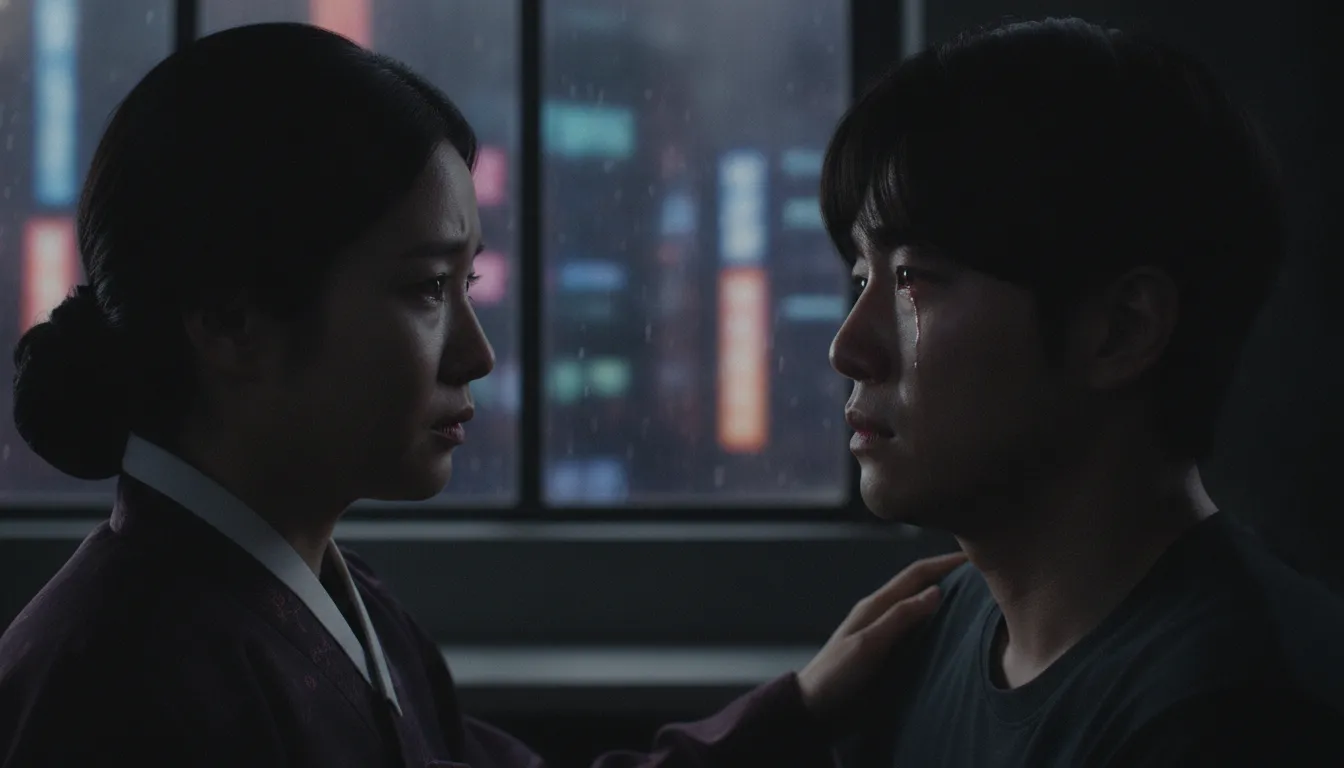
Jae-hyun's shoulders shook first. The sound followed a long while after. It was low and rough. Different from a gokbi's crying. No rhythm, no rise and fall. Just the sound of collapsing. Yeo-ok didn't pat his back, just stood beside him and watched two buses pass.
Jae-hyun wiped his eyes with his sleeve.
"Sorry. This isn't the place for this."
"This is exactly the place for it. You buried your mother today."
Jae-hyun laughed. It was a face with crying and laughing mixed together.
"I think it's thanks to you, Yeo-ok. Earlier, when you stopped — ever since I saw that, something kept rising up in me."
"I didn't do anything."
Yeo-ok touched the crumpled paper in her pocket with her fingertips. She didn't throw it away.
Back home, Yeo-ok sat at the kitchen table without even taking off her coat. The unopened packet of medicine was still there. She picked it up, went to the freezer, and pushed it in behind the bag of frozen dumplings, beside the other half. Her fingertips were cold as she shut the door.
She took the recorder out of the drawer. The tape seemed to have stretched; the playback was just a touch slower than before. Da-in's voice came out lower than it used to.
"Mom, look at this. My tooth fell out."
Twenty-two years, and even magnetic tape grows old. Yeo-ok noticed that fact for the first time today. She tried to check the sequence — the truck's headlights, the wet asphalt, one lone shoe. But today, before she'd even counted to one, before she could fill in three, a sound rose up from the back of her throat.
Yeo-ok pressed her forehead to the table. It wasn't a gokbi's crying. No rhythm, no rise and fall. Just the sound of collapsing. The recorder reached the end of the tape and clicked to a stop. Yeo-ok heard the sound but didn't reach for it. She didn't rewind. She let her shoulders shake as they would.
A long while later, Yeo-ok lifted her head. Her eyes were swollen. She reached out and picked up the recorder. She pressed rewind. The tape wound back slowly, with an old, aged sound. Yeo-ok sat still and waited, fingertips cold, for that sound to finish.