The cooling unit groaned. The clinic's temperature was set to 22 degrees, but the 54 degrees outside seemed to seep in anyway, as if it were melting the glass and prying through the insulation in the walls.
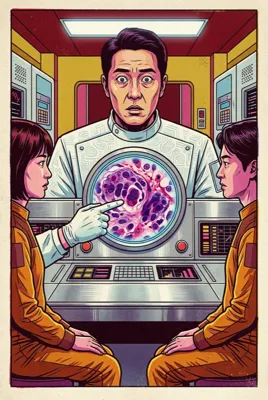
The man turned a dial, lowering the output of the vital-sign stabilizer by 3 percent. The pale green solution flowing through the transparent tube slowed. The needle in the woman's arm, connected to her as she lay half-reclined in the chair, trembled faintly. Her eyes were closed, but the muscles of her jaw were clenched tight with tension.
"We're almost done."
The man said it, his voice dry as a machine's. He looked down at the faint pattern etched into the inside of the woman's forearm — a shape somewhere between a leaf and a flame. It was the Mark, the trace left on the skin of everyone who had undergone Therma-G, the heat-resistance gene therapy. The Mark stayed blue as long as the nanomachines in the body maintained the genetic modification, then gradually faded to gray as Reversion — the removal procedure — progressed. The woman's Mark had now nearly lost all its color.
The man — Minjun — bore the same Mark on his own forearm. His was still a vivid blue.
"So... now, if it gets hot, will I die?"
The woman asked without opening her eyes. Her voice came out cracked.
"You won't die. But in a 'Red Zone,' where the average temperature exceeds 40 degrees, you'll be required to wear a cooling suit whenever you're active there. That's not a recommendation — it's the law."
"So I'll just... become an ordinary person."
"That's right."
Minjun answered as he connected the last vial to the stabilizer — the final stage of Reversion, the neutralizing agent that deactivated the modified genes and restored the body's temperature regulation to its original state. Twenty years ago, his father had said this technology would save humanity. In the years when killing heat paralyzed cities and food production collapsed, Therma-G — which began in rat trials — had seemed like a miracle. A gene therapy that lowered body temperature by 2 degrees and increased sweat efficiency by 300 percent, letting people function in 60-degree environments without a cooling suit. It was distributed first to dockworkers, construction crews, and city infrastructure managers. They were hailed as heroes, holding up a world collapsing under the heat.
The bill started coming due fifteen years later. The modified genes, in exchange for survival, triggered abnormal cancer-cell proliferation — a new cancer, called Mark Tumor. The government folded Reversion into standard health insurance, but the choice was left to each person: risk cancer for freedom in the world outside, or go back to the old, heat-vulnerable body and spend the rest of your life dependent on cooling facilities.
Minjun was a Reversion Technician. His job was turning people from heroes' bodies back into ordinary ones.
The stabilizer chimed a bright, cheerful alert. The procedure was over. Minjun withdrew the needle from the woman's arm and pressed an antiseptic swab to the spot. Her Mark now remained only as a fully faded, gray smudge.
"You may feel dizzy or chilled for about a week. That's just your body readjusting to the heat again. Take the temperature stabilizer I've prescribed you."
The woman slowly rose. Even in the 22-degree room, cold sweat beaded on her forehead. She wrapped her arms around herself, as if feeling cold for the first time in decades.
"Thank you."
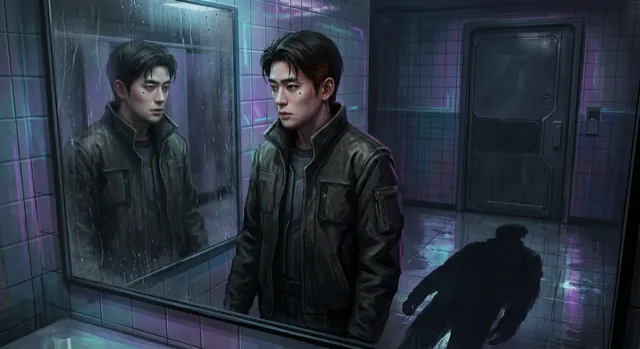
She glanced briefly at the blue Mark on Minjun's arm, then looked away. The Technician performed the procedure, yet he himself had never undergone Reversion. Many clients looked at him with that same expression. Minjun was used to it.
After the woman left, Minjun put away the procedure tools. He loaded the instruments into the automatic washer and ran the sterilization cycle. Beyond the window, the city shimmered in the heat. The air rippled with warmth, blurring every outline like a mirage. The metal surfaces of heat-shielded vehicles moving along the roads threw back the blazing sunlight in dizzying flashes. People moved only through underground passages or cooling tunnels. Out there was a world that belonged to those who had received the Therma-G procedure.
His personal terminal vibrated. On the screen was an official notice from the Public Health Information Service (PHIS).
[Recipient: Jiho Min (c/o Guardian Minjun)]
[Subject: Notice of High-Risk Classification for Therma-G Mark Tumor and Recommendation for Reversion Procedure]
He felt his heart drop, cold. His son, Jiho. Seventeen this year. The age at which adolescents who had undergone the Therma-G procedure medically entered the period of sharply rising Mark Tumor incidence.
Minjun swiped the notice downward. The expected phrases were all lined up. "34.5% probability of tumor onset within the next five years." "Under 1.2% incidence with early Reversion procedure." "Decision recommended within six months." His wife had received the very same notice. She had put off Reversion, and two years later the tumor was found — by then, it was already too late.
As he put away the disinfected instruments, Minjun looked out the window. His son was somewhere out there right now. Maybe riding heat-shielded skateboards with friends, or exploring the abandoned buildings on the city's outskirts — free of the bulk of a cooling suit, feeling the wind on bare skin. To Jiho, the world outside was a playground, and Therma-G was the ticket in.
Quitting time. Minjun switched off every power source in the clinic and stepped into the hallway. The whole hospital was cool as a giant refrigerator. He took the elevator down to the tunnel platform on B3. Getting home meant traveling twelve blocks through the cooling tunnels. The tunnel was crowded. Most were like Minjun — unmarked — or else people whose skin had turned ash-gray. The "Reverted." They leaned against the walls, seeking out whatever cooler spot they could find, pale and exhausted faces bent over their terminal screens.
Now and then, people bearing the blue Mark passed through the crowd, brows furrowed as if the tunnel's chill offended them. They looked like a different species entirely — stronger, freer, and shorter-lived.
Minjun boarded the tunnel tram. The closer he got to home, the heavier his heart grew. How should he even begin telling his son? His wife had said it once: this body is borrowed time. We didn't escape the heat — we let a different kind of fire into our bodies. Someday, that fire would burn us. Minjun thought she'd been right, but Jiho would be different. To a seventeen-year-old, cancer in some distant future wasn't real. What was real was the plain fact that tomorrow, he wouldn't be able to run wild with his friends anymore.
The apartment complex was covered by a massive shading dome to keep out the heat above ground. Inside the dome, the temperature held at 35 degrees — still hot, but a space where Reversion Technicians could walk a short distance bare-skinned. The bare minimum. Minjun stopped for a moment at the entrance to Building 107 and looked up at the dome's ceiling. Through the translucent panels, he could see the sky burning red. Out there was the real world. And his son belonged to it.
The front door's digital lock clicked open with a faint mechanical sound. The air inside the apartment was colder and drier than a hospital corridor. The AI-controlled optimal temperature: 21.5 degrees. Minjun stood at the door for a moment, feeling the subtle sensation on his skin where the heat outside collided with the chill within. On the hallway mat — the one he and his wife had picked out together, its color faded now — dry, dusty footprints were scattered in disarray. Traces of his son, just home.
"Jiho."
At Minjun's call, the shadow stretched out on the living room sofa stirred. Jiho was hunched over his terminal, headset on. Sweat-soaked hair clung to his forehead, and the forearm exposed beneath his short-sleeved shirt was a healthy, sun-browned copper. And there, glowing vivid and blue, was the same Mark as Minjun's own. His son pushed the headset half off one ear and answered without much interest.
"Oh, you're home?"
"You're back early today."
"It's hot out. Nothing else to do outside anyway."
Jiho said this without ever taking his eyes off the terminal screen, where gunfire and explosions blared. Minjun wet his dry lips and moved closer to his son. On the living room table, energy bar wrappers and empty drink cans lay strewn about. Faintly, Jiho's body carried the smell of the outside world — scorched asphalt, dust, and ozone, all mixed together.
"Have you had dinner?"
"Not yet. I was going to order delivery."
"Let's eat together. I'll make something."
Minjun headed for the kitchen, trying to keep the conversation going. How should he bring it up? Should he just show the boy the notice, or explain it fully first and win him over? In moments like this, his wife had always been wiser than him. She'd known how to talk to their son at his own level. You're too stiff, Minjun. Sometimes just holding someone is worth more than a hundred words. Her voice seemed to linger in his ears.
Even as he pulled ingredients from the refrigerator, Minjun could feel his son's indifference pressing into his back. Jiho was absorbed in his virtual combat. What was real to that boy? This cool, safe apartment — or out there, running with his friends in 54-degree heat?
"Jiho. Today… a notice came."
In the end, Minjun broached it in the clumsiest way possible. The hand that had been cutting stopped mid-motion. The sound of the game from the living room cut off too. A silence stretched out. Even without turning around, Minjun could picture his son's expression.
"What notice."
The voice was calmer than expected, but edged. It meant he'd already guessed.
"From PHIS. You must have gotten one too."
"...Oh, that. I thought it was spam and deleted it."
Jiho rose from the sofa; Minjun heard it. He came to lean against the kitchen doorway, arms crossed. At seventeen, his frame already had an adult's bones. Minjun felt his son looking down at him.
"You shouldn't have deleted it. It's important."
"Obviously. It's too dangerous now, so go back to your old body. Live out the rest of your life in this refrigerator of a house. Right?"
The tone was mocking. Minjun turned slowly to face his son. Jiho's eyes were full of defiance.
"It is dangerous. Your mother too—"
"Don't talk about Mom."
Jiho cut him off. His jaw set hard.
"Mom chose it. To live out there until the end. That was her freedom. But you keep calling it a regret."
"That wasn't freedom! A choice that ends in death isn't a choice."
Minjun's voice rose before he could stop it. Jiho scoffed.
"Then what about you?"
His son's gaze went to the blue Mark on Minjun's forearm. Just like the woman in the clinic today, just like countless other Reversion cases before her — now even his own son was looking at him with that same look.
"Why don't you Revert? Aren't you in danger? You're always turning everyone else's body back to the old way, so why do you stay the same? You like it out there too. Sometimes when you go out on weekend perimeter patrol, you look thrilled."
"That's... that's work. As a Technician, I—"
"Don't hide behind work. You just can't give it up either. Walking in the wind without a cooling suit. Seeing that red sky with your own eyes, even just once in a while. You think I'm any different? I live like that every single day! That's my whole world. And now, after all this, you want to take it all away and make me live like a ghost in the underground tunnels?"
Jiho's voice was shaking with anger. He kicked an empty can off the living room table in a fit of rage. The can flew and struck the wall with a loud clatter. Minjun could say nothing back, because every word of it was a painful truth. He too loved the brief moments of freedom this blue Mark gave him. After his wife died, he'd sometimes deliberately volunteered for patrol duty in the Red Zone. Standing alone in the middle of that blazing world, he felt as though he were with her again. In the world she had loved.
"Next month there's the 'Solar Race.' It's held on a closed-off highway, and if you win you even get a university recommendation. I promised the guys I'd enter. If I Revert, it's all over. It's just over."
Jiho spoke desperately. For a seventeen-year-old, a university recommendation and a promise made to his friends were far heavier, far more real problems than some vague 34.5% probability.
"You're willing to risk your life for a race like that?"
"You're risking your life for Mom!"
His son's cry split the ice-cold air of the house. Minjun felt as if he'd been struck in the head with a hammer. His son knew. He'd dimly guessed at least half the reason Minjun couldn't bring himself to Revert—atonement for his wife, or an unwillingness to let go of the world she'd left behind. Minjun opened his mouth to explain himself, but no words came. Instead, something hot surged up from deep in his chest.
Jiho said nothing more. He stormed into his room and locked the door. A moment later, music loud enough to bleed through a headset began to seep faintly through the wall. Minjun braced both hands limply against the cold countertop. On the cutting board lay vegetables, half-chopped and abandoned. Outside the window, beyond the dome, the sky was deepening now into a dark violet. Summer's bill always arrived addressed to the name of the person you loved most. And its weight was never something you could bear alone.
Minjun stood there for a long time. The aggressive beat of the music leaking from Jiho's room seemed to lash at the artificial stillness of the house. He ran a hand over the countertop, gone cold. His son's cry hadn't been mere rebellion. It had been an accurate diagnosis—a truth Minjun had refused to admit even to himself. His wife had proven her choice with her death, and their son remembered that death as a symbol of freedom. And he himself was caught between the two of them, hiding behind the safe profession of Reversion Technician, chasing his wife's ghost.
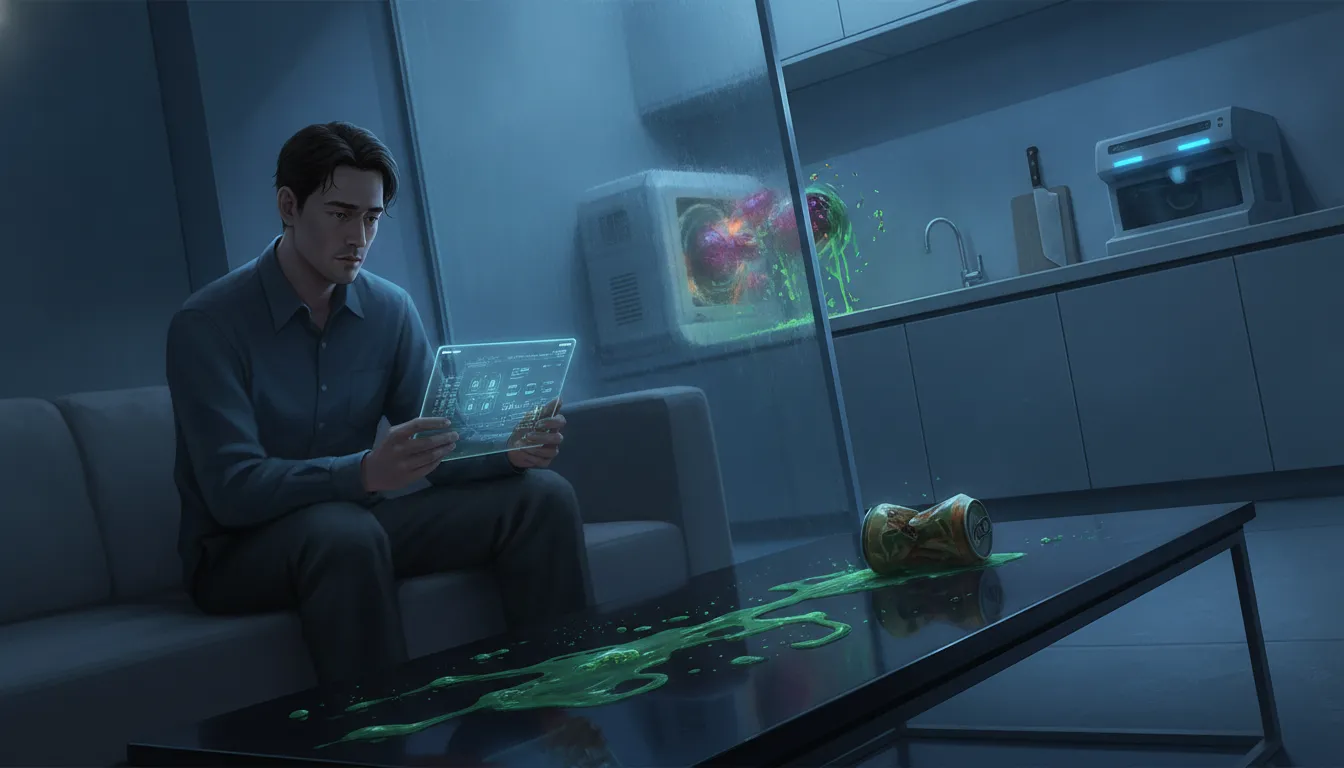
In the end, he gave up on dinner. He fed the half-chopped vegetables into the food disposer and loaded the cutting board and knife into the washer. Amid the dry whir of the machine, he went out to the living room and sank onto the couch. On the table, a soda can Jiho had kicked lay crumpled on its side. Minjun opened his personal terminal and searched for 'Solar Race.' Illegal sites, accessible only through the dark routes, filled the screen. He tapped the topmost link, and a video appeared: an abandoned highway shimmering with heat haze under a blazing sun. Kids on heat-coated boards tore across the asphalt at near-acrobatic speeds. The camera shook, wind noise cutting in roughly. In the footage, the kids were laughing, shouting. Alive. Minjun searched the video for his son's face. The vitality those kids radiated was beyond comparison to the pale faces of the underground tunnels. This was the world Jiho was trying to protect. The world his wife had loved—and the world he himself could not entirely let go of.
Several days passed. With no words exchanged, the air in the house sank colder still. Minjun and Jiho treated each other like invisible walls, moving only within the barest necessary paths. They ate separately, each in his own room; when Minjun left for work, Jiho was asleep, and when Minjun came home, Jiho was shut away in his room. The artificial chill leaking through the gap under Jiho's door wound itself around Minjun's ankles.
At the clinic, Minjun handled his patients mechanically. Staring numbly at Marks fading to ash-gray, he kept seeing the vivid blue flame that had once burned bright on his son's arm. The knowledge that he would have to snuff out that flame with his own hands pressed on his chest like a slab of lead. His son's words—the cry, "You're risking your life for Mom, aren't you!"—rang in his ears like tinnitus. Was that really true? Was he unable to let go of this dangerous freedom because he was still chasing his dead wife's shadow? And if so, what right did he have to force Reversion on his son?
That night, unable to sleep, Minjun opened the box that held his wife's belongings. Inside were dust-covered data chips, a few faded photographs, and the heat-shield goggles she used to wear. She had been a plant restoration researcher on the city's outskirts, reviving the genes of species wiped out by the heat—work that would have been impossible without the Therma-G procedure. She had loved her work, and had never feared throwing her body into the scorched earth. To her, the blue Mark had not been a curse but wings. Minjun lifted the goggles and held them to his eyes. Beyond the lenses, the familiar living room looked faintly distorted, as if it were another world. He tried to imagine the world she must have seen through these goggles—the blazing sun, the earth shimmering with heat haze, and the small living things that bloomed in defiance of it all. Under that same searing sun, heat haze seemed to rise beyond the fine scratches left on the lenses.
The next day, Minjun came home earlier than usual. Jiho was still in his room. Minjun stood in front of his son's door for a moment, hesitating. He drew a breath, then knocked.
"Jiho. It's me."
There was no answer from inside. No music, either. Minjun knocked again.
"Let's talk."
After a long moment, the door opened. Jiho looked up at his father, his eyes full of wariness. Without a word, Minjun held out his wife's goggles.
"This…"
Jiho took the goggles. They were an old model, but clearly professional equipment. Faint scratches marked the lenses, traces of old heat.
"They were your mother's."
Minjun said.
"That race you're set on running—it'll be dangerous. Of course I'm against it. That much hasn't changed."
Disappointment and anger rose in Jiho's face again. He started to shut the door.
"But,"
Minjun went on. He didn't hold the door to stop it from closing. Instead, he looked his son straight in the eye.
"I think I understand now—a little—why you can't give it up. Your mother couldn't either. So… I'm not going to let you go alone."
Jiho's hand stopped.
"What do you mean?"
"Race in the competition. But there's a condition. I'll go along as your team's medical support officer. I'll monitor your vital signs in real time, and if anything even hints at a dangerous reading, the race ends right there. And once the race is over, then we'll talk again — about how we're going to pay this bill."
Minjun's voice was dry, the way it always was when he spoke as a Technician, but it carried a faint tremor that hadn't been there before. If he couldn't stop his son's choice, then he had no option but to walk with him into the middle of the danger.
Jiho looked at his father for a long moment. Instead of answering, he let the tension go out of the hand still gripping the door. He turned his head and looked down at the goggles in his hand. His mother's warmth seemed to linger there, faintly. At last, Jiho gave a small nod.
That weekend, Minjun went outside the dome with Jiho. It was the first time since his wife's death that he'd gone out for anything other than official business. Air past fifty degrees hit his bare skin, unprotected by a cooling suit — a sensation both familiar and foreign. Every sweat gland on his skin seemed to scream open at once. Jiho was already well ahead, scouting the route toward the closed highway. Minjun called out to his son's back.
"Don't get too far ahead! Stay with me!"
Jiho glanced back and gave a wry smile — just the corners of his mouth lifting, awkward, but with no trace of reproach in it. Minjun followed after his son, slowly. Heat rising off the scorched asphalt burned through the soles of his shoes into his feet. Their two shadows stretched long across the pavement. From somewhere, faint in the shimmering heat, came the first cry of a summer cicada — the kind that only sings in weather like this.