Particles of light drifted above the glass panel. Seo Yujin scattered them with her fingers. Hundreds of millions of points swirled in the wake of her touch, then condensed into a new form. It was a failure. Not the curve she'd intended. A rough, unpredictable protrusion that would snag a user's eye. Yujin frowned and swept the whole composition away. Darkness settled over the empty panel again. Four hours now, the same task, over and over.
Only two days remained until the new interface concept was due. The client wanted something "innovative yet stable" — a contradiction in terms. Finding a path through the gap between those contradictions was Yujin's job. She reached out again and summoned the particles into the air, slower and more deliberate this time. The sensation of her neural net catching fire. The faint tremor just before an idea takes shape. At that exact moment, a low notification chime cut through the air of the studio.
In one corner of the panel, a green envelope icon blinked. An official notice from the National Health Coordination Center. Yujin stopped what she was doing. Notices like this were usually reminders for a routine checkup or something to do with taxes. She opened the envelope, and a sentence rose up in soft-edged type.
[Congratulations, Seo Yujin. You have been selected for regular screening under the National Quantum Brain Early Diagnosis Program. Please join us in taking a step toward a healthier tomorrow and a more stable society.]
Her heart gave a small lurch. The word "selected" was one of those words often used for notifications that left no room for choice. She knew the program's name well. Introduced three years ago, it had become a kind of rite of passage every citizen passed through in turn. A technology that fully simulated the quantum state of the brain, catching the seeds of potential illnesses — dementia, psychiatric disorders — decades before they appeared. Television ran endless segments touting its benefits. Thanks to it, they said, the incidence of major neurological disorders had dropped more than 80 percent in a decade.
The notice stated that the screening procedure was simple, painless, and would take only 30 minutes. The earliest available appointment was the following Tuesday. Yujin hesitated a moment, then pressed confirm. She could have refused, technically — but no one ever did. A citizen's natural duty, contributing to the health of the community. That was what everyone said.
A week later, Yujin sat in the Coordination Center nearest her home. The interior felt less like a hospital than a high-end spa. Soft lighting, low classical music, a soothing scent diffused into the air. Everything had been carefully designed to ease a visitor's tension. When her name was called, Yujin followed the attendant into the scanning room.
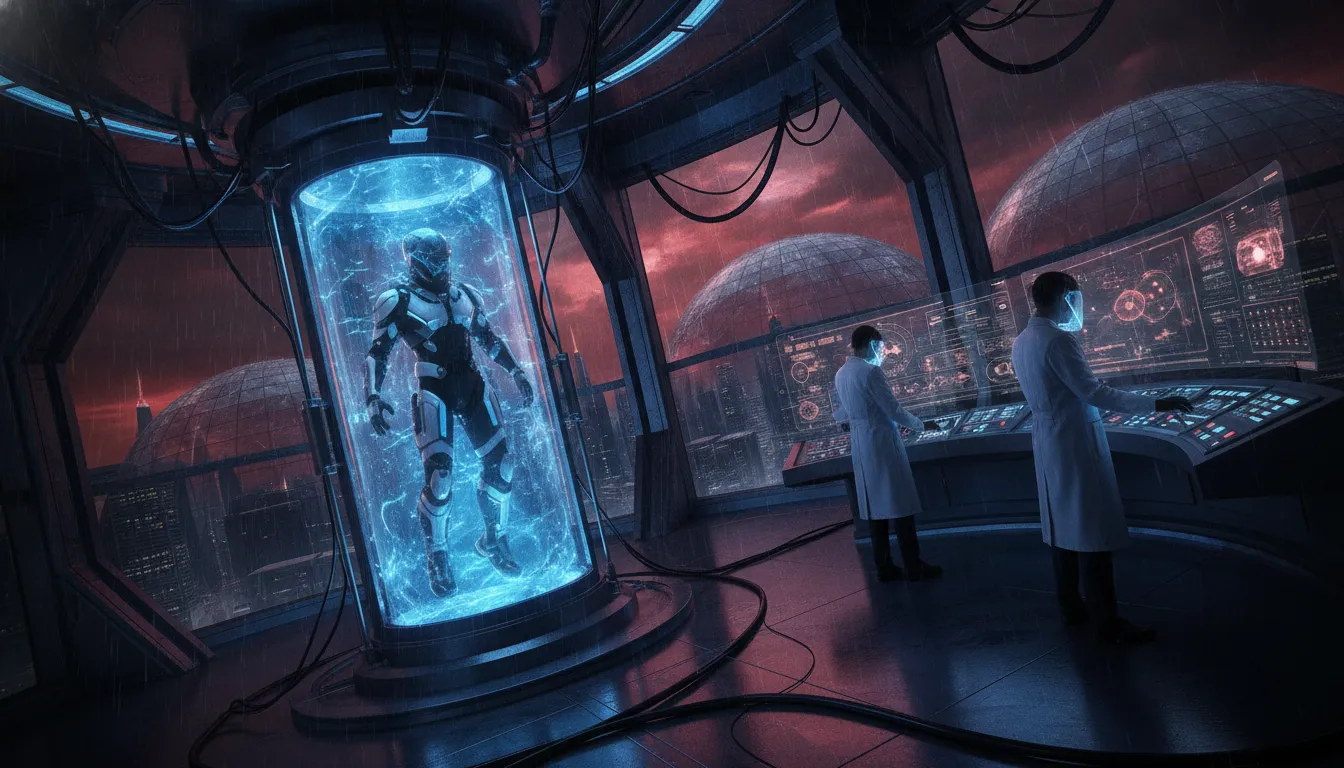
At the center of the room stood a massive white ring-shaped machine — less imposing than sculptural. The attendant seated Yujin in a recliner beneath the machine and attached a few small sensors to her forehead and temples. The touch of the cold gel felt strange.
"You'll be put into a brief sleep state. It will be a very comfortable experience. Sweet dreams."
With the guide's voice, her consciousness sank gently under. A sensation like passing through a tunnel of mingled colors and light. That was all. When she opened her eyes again, she was sitting on a sofa in a different room. Her body felt refreshed, pleasantly languid, as if she had just woken from a nap. Through the window she could see a well-tended garden.
"Seo Yujin, your examination is complete."
The man seated across from her said, smiling. On the name tag pinned to his white coat was printed: Park Seonwoo, Cognitive Harmony Counselor. He handed Yujin a cup of warm tea.
"The results are quite fascinating. You have a very creative pattern of brain activity, Yujin."
Park Seonwoo tapped the table lightly. Its surface turned into a screen, and a 3D visualization of Yujin's brain activity rose into the air. Thousands of glowing lines wove together in intricate tangles, like a galaxy. It was beautiful.
"As you can see, the signal exchange between your frontal and temporal lobes runs 37 percent more active than average. It's the pattern usually seen in artists and researchers — directly tied to the ability to generate new ideas."
His tone was complimentary, but Yujin felt an obscure discomfort. It was as if her own mind had been stripped bare and put on display.
"Although… we did find a few patterns that would benefit from some management."
Park Seonwoo zoomed in on part of the screen. At the center of the galaxy appeared a region that shone almost too brightly, crackling like an unstable nebula. Red and violet bled together, giving off a sense of instability.
"We call this region an 'overcomputation loop.' It shows a tendency to explore an excessive number of possibilities in response to a given stimulus, to reject established solutions, and to insist on inefficient paths. It often appears alongside signals of an inherent resistance to social norms or general consensus."
His finger pointed at the red region. Yujin held her breath. She thought of herself hunched for hours, tearing apart and rebuilding her work out of frustration with a client's demand for something 'innovative yet safe.' If she'd simply followed the existing design, she'd have finished long ago.
"This doesn't mean it's a disease — please don't misunderstand. It's closer to a 'precursor symptom,' nothing more. We classify it as an early stage of what we call Cognitive Misalignment Syndrome, Type R."
"Type R?"
"Rejectionist. It means the rejecting type. Left unaddressed, it's a potential risk factor that can lead to chronic dissatisfaction, defiance of authority, and social isolation — not to mention a decline in productivity."
Park Seonwoo's tone remained soft and gentle throughout, as though he were a doctor recommending a dietary adjustment for slightly elevated blood pressure.
"Fortunately, I have very good news. You're an ideal candidate for our Cognitive Harmony Program. It's a simple, non-invasive sonic therapy — just fifteen minutes, once every two weeks, for three months. It will recalibrate this unstable overcomputation loop into a stable state, reducing unnecessary mental strain and sharpening your focus. You'll find yourself thinking far more calmly, and far more efficiently."
"Calm. Efficient." Yujin repeated the words to herself. She thought of the "rough, unpredictable protrusion" that had tormented her the night before. It was a product of inefficiency. And it was also the most original thing she had ever created.
"After the treatment... what happens to my work?"
"It'll only get better, of course. Most designers report a sharp rise in client satisfaction after treatment. You let go of unnecessary stubbornness, and produce clearer, more effective results."
Park Seonwoo smiled brightly and held out a brochure. On the cover were the words A Prescription for Silence. Beneath them, over the image of a placid lake, ran the slogan: A steadier you, a happier us. Inside, the brochure was full of glowing testimonials from those who had completed the treatment.
"I don't lie awake anymore over pointless thoughts."
"The world feels so much simpler and clearer now."
"I can't even remember why I used to be angry at everything."
Yujin left the counseling room, brochure still in hand, her mind in disarray. There had been no coercion in anything Park Seonwoo said. Every word had been offered for her health and happiness. But the "abnormality" they had found in her brain was precisely the thing she had always considered part of herself — the tendency to doubt, to resist, to go on restlessly searching for something new. That, they said, was the sign of a disorder taking hold.
Back in her studio, Yujin stood before the blank glass panel. She reached out again, summoning motes of light. And before she knew it, without meaning to, she was tracing in midair the very shape she had seen glowing red and violet in the brain scan back in the counseling room — that unstable, jagged nebula.
It looked almost like a declaration — an act of affirming her own flaw, or perhaps her own identity. But the shape was so chaotic that Yujin couldn't bear to look at it for long. She wiped the image away with her palm. In the darkness that rushed back in, her face was faintly reflected — furrowed brow, lips pressed shut. It looked exactly like the picture of "chronic discontent" that Counselor Park Seonwoo had described.
She pulled up the client's requirements on the panel again. "Innovative, yet stable." The words felt like mockery now. Stability. Efficiency. Calm. Every value the National Health Coordination Center promised. Perhaps what the client really wanted wasn't a new design at all, but something more like the output of a designer who had gone through the Cognitive Harmony Program — predictable, never unsettling to the user, delivering the optimal answer within established norms. A design that did not resist.
"Yujin, still working? It's already past eight."
A cheerful voice came from over the partition. It was Minjun, her teammate. Looking as though he were already dressed to leave for the day, in a light jacket and coffee cup in hand, he strolled over to Yujin's workspace. He always carried a neat, tidy scent about him — just like his designs.
"Oh — yeah. The draft's just not coming out the way I want it to."
"Let's see."
Minjun leaned over Yujin's shoulder to peer at the empty panel.
"Hm, really nothing there. This client's a bit difficult, isn't she. They toss around the word 'innovation' too freely. What they actually want is just a polished sense of stability."
Minjun was one of the fastest designers in the industry. He had an uncanny knack for reading a client's unspoken intentions, and more often than not, a single draft was enough to get a project approved. His work was clean, seamless, without a trace of excess. Everyone praised his efficiency.
"Have you ever... felt lost while working? Like everything you try keeps going sideways, and you get this urge to throw it all out and try something completely different."
Yujin asked cautiously. Minjun seemed to mull over the question for a moment, then answered with a bright, clear laugh.
"Hm... I think I used to, yeah. Up until my third year. I'd get hung up on some pointless idea and end up pulling all-nighters before deadlines. But at some point I realized it was all just a wasted war of attrition. What matters isn't my personal artistic vision — it's solving the client's problem. Once you focus only on what's essential, the path becomes perfectly clear."
His voice was so calm, so full of certainty, that Yujin momentarily lost her words. It was as if the testimonials printed in the brochure were pouring straight out of his mouth. The world became so much simpler and clearer.
"I went in for the national screening not long ago..."
Yujin found herself starting before she'd decided to.
"Have you ever heard of 'Cognitive Misalignment Syndrome'? Type R?"
The moment he heard the term, Minjun's expression brightened, faintly. It was the look of someone who'd just recognized a kindred spirit.
"Ah, so you got tested. Did you get a diagnosis? I got an early-stage Type R diagnosis myself, two years ago. It was a bit of a shock at the time, but looking back now, it was the turning point of my life. And of course, I went through the Cognitive Harmony program too."
"...What was it like, after the program?"
"Best thing I ever did."
Minjun answered without a shred of hesitation. He tapped lightly at his temple.
"Like the fog that was always sitting in my head just lifted, completely. Before, the second I came up with one idea, dozens of tangled offshoots would sprout off it until I felt like my skull would split. I couldn't even tell which direction was the right one. Not anymore. Now the most efficient route just shows itself, like a GPS. My work time's been cut in half, and my approval rate's up 200 percent."
He spotted the brochure for A Prescription for Silence lying on Yujin's desk and picked it up, pleased.
"Oh, they're still using this design. Yujin, you should really try it too. There's nothing to be afraid of. It just cures the inefficiency that's been making us sick. Think of it like a vaccine, sort of."
Minjun set the brochure back down neatly and gave Yujin's shoulder a light pat.
"Don't agonize over it too long, Yujin. You know all that agonizing is just 'excess computation,' right? Wrap it up quick and head home. See you tomorrow."
He left the office with a brisk, refreshed stride. Alone again in the empty space, Yujin unconsciously rubbed the shoulder Minjun had touched. The spot where his hand had rested felt cold. Navigation. The most efficient route. Pruning away unnecessary branches. That was Minjun's secret. The "jagged, unpredictable protrusions" that Yujin had spent the last four hours conjuring and demolishing, over and over, simply didn't exist in Minjun's world.
She stood before the glass panel again. She had to draw something. She had to answer that contradictory demand — innovative, yet stable. But now every particle of light blooming from her fingertips filled her with doubt. Was this idea creativity, or a symptom of illness? Was this hesitation prudence, or just an inefficient loop repeating itself? Counselor Park Seonwoo's gentle voice and Minjun's bright laughter tangled together in her head, ringing like tinnitus.
Yujin closed her eyes. She needed silence. But what she found was not silence — it was the clamorous quiet of some nameless nebula still burning, unstably, red and violet, somewhere inside her brain.
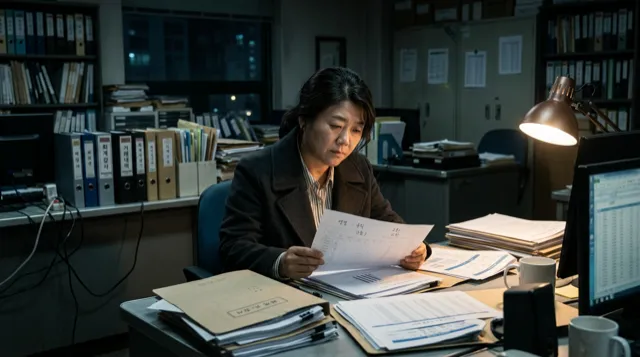
Yujin shot up from her seat. The controlled air of the studio seemed to squeeze at her lungs. If she stayed like this any longer, she felt she'd end up bewitched by the "navigation" Minjun had spoken of, choosing the safest, most tedious route without even realizing it. She threw on her jacket and left the office. The nighttime city was filled with the precise lines of light, like some vast circuit board. Self-driving cars glided along their fixed tracks without a sound. Everything hummed along efficiently within a perfect order. And within it, Yujin felt a strange, alien sense of having become a defective part.
Her steps wandered without destination until they turned into a familiar alley. She saw a worn sign that read "Bookshop of Silence." Not a place for AI-recommended e-books, but one that sold old paper books, handpicked by a person. She couldn't remember the last time she'd come here. When she opened the door, an old wind chime jingled, and the smell of aged paper and dust greeted her. The old man who owned the shop peered at her over his thick glasses.
"Welcome."
She gave a light bow and walked slowly among the disorderly shelves. A search with no algorithm's intervention — surrendering entirely to chance and instinct. Her fingers stopped on an old book of poems. Insurgent Stone. Even the title read like an R-type manifesto. She turned the pages. Unpredictable line breaks, combinations of words whose meaning she couldn't parse, a succession of images that defied logic. Minjun would have called it "the height of inefficient communication." But Yujin felt a kind of liberation in those chaotic sentences. The red nebula in her brain seemed to resonate, quietly.
"Picked yourself a headache of a book."
The owner had come up beside her without her noticing, his voice low. His eyes moved back and forth between the poetry book in her hand and her face.
"Everyone's after easy and comfortable these days. This world treats anything complicated like a disease."
His offhand remark struck straight at Yujin's heart. Before she knew it, she was asking.
"But if it's a disease... shouldn't it be treated?"
Instead of answering, the old man ran a hand slowly along a dust-covered spine. Then he said.
"Once you straighten every road out flat, there's no shade left to rest in."
He said nothing more and returned to his seat. Yujin stood there a long while, the book of poems held to her chest. A place to rest in the shade. Was that, perhaps, what the "rough, unpredictable protrusion" she'd built and demolished over and over these past four hours had really been? Useless from the standpoint of efficiency, but a small patch of shade where someone might pause and see the world differently. The book's rough-textured cover felt good beneath her fingertips. She still hadn't decided anything. But she'd gained, at least, the faint comfort of knowing the world didn't hold only a single right answer.
As Yujin stepped out of the bookstore, the cold night air brushed her cheek. The city still shone with its usual flawless precision, but that perfect order no longer looked beautiful to her the way it once had. The rough cover of the poetry collection in her hand, Insolent Stone, felt strange yet somehow comforting. Between the neatly laid pavement blocks along the street, she noticed a single unnamed weed pushing up through a tiny crack. It was a sight she would never have once bothered to notice.
The office was as quiet and empty as it had been when she'd left. She set the old book of poems on her desk, right beside the glowing glass panel. It was as if two different eras, two different worldviews, were precariously coexisting on that small desktop. She sat down and pulled up the National Health Coordination Center's notice on the screen once more.
"Schedule Your Cognitive Harmony Program." The soft green button beckoned to her. Minjun's face, brimming with certainty, Counselor Park Seonwoo's gentle smile, the tranquil lake from the brochure — they surfaced one after another. A Prescription for Silence. All of them had said it was for Yujin's own good. For a happier, more stable life. Maybe they were right. A life that shed unnecessary anguish and walked a clearly marked path would surely be comfortable.
But the old man's voice lingered in her ears. "Once you straighten every road out flat, there's no shade left to rest in." Shade. The rough protrusion she'd built, then torn down. Inefficient, but a place where someone's gaze might rest a while. An innate signal of resistance against norms the society had decreed. Type R. Rejectionist.
That was not a disease. It was herself. Imperfect, at times inefficient, endlessly doubting, endlessly resisting — that was who she was. Without that chaotic red nebula, she would never have suffered this much in the face of the contradictory demand to be "innovative yet stable." She would probably have done just as Minjun did — read the client's hidden intent and found the safest possible path. But was that truly her design? No — was that truly her life?
Beside the reservation button, in print so small that most people never noticed it existed, was a link that read 'Postpone or Refuse Treatment.' Yujin held her breath for a moment. Then, without hesitation, she clicked it.
The page changed, opening a window that asked for her reason for refusal. It was a required field. She imagined, briefly, how the system would collect and analyze the data of the small minority who refused. Her refusal, too, would become just another object of management. And yet, her hand moved to the keyboard anyway.
[Reason: Wish to preserve current identity in a state of cognitive misalignment.]
The moment she pressed Enter, a cold confirmation message appeared on the screen. [Processed. Your choice is respected, but the associated data may be referenced in future analyses of social stability.] A chill of warning lurking behind the word respected. Yujin simply closed the window. Astonishingly, she felt no fear. If anything, the ringing that had filled her head fell silent, and something like true quiet settled in its place. It was not a calm injected from outside, but a solid silence she had won for herself, by her own choice.
Yujin reached out again toward the empty glass panel. Particles of light rose up into the air in answer to her call. She no longer thought of the client's demands. She erased words like 'innovative' and 'stable' from her mind as well. Instead, she summoned the image that had crackled and burned inside her head — that beautiful, unstable nebula.
Her fingers began to move. It was not a smooth curve. It was a line that deliberately jutted out, rough and unpredictable. A shape that seemed on the verge of breaking, then continued on, suddenly changing direction to reach into another dimension entirely. A protrusion that disrupted the viewer's gaze and betrayed every familiar expectation. It was the very shape she had branded a failure and erased, only hours before.
It was no longer a mistake. It was the one solid point from which everything would begin. At her fingertips, the red nebula that had burned so unstably bloomed — quietly, and with resolve.