The way the plastic chair clung to his skin was always unpleasant. The man watched the age spots on the back of the old man's hand across from him and waited his turn. A hologram number hovered above the old man's hand. 82. His onset date. With a composed expression, the old man was listening to the interest rate on the last loan product of his life. The teller's voice was as flat as a recording. "Your remaining life value has been calculated at 14 months. This product, using all of your assets as collateral, pays out in advance the dignity-management costs incurred after your onset date—"
Ihyeon turned his head away. The air in the Integrated Life Management Center was always cool and dry. A place where people who had been notified of their onset date exchanged their remaining time for financial products. He was a data technician, dispatched here to inspect the system. His job was neither teller nor counselor. He had come to check the tail end of the data pipeline that made all of these transactions possible.
He walked toward the junction box mounted on the wall behind the counter where the old man sat. He checked the cables' connections and measured the signal strength with his handheld terminal. A green light came on. Normal. Everything was moving according to protocol. His own information flickered briefly across the terminal's screen.
[Kang Ihyeon. Affiliation: Life-Cycle Prediction (LCP) Consortium, Data Integrity Team 3. Onset date: age 41. Remaining term: 1 year, 7 months, 4 days.]
He switched off the screen. The number 41 had trailed him since birth. It was spelled out on his elementary school admission notice, on the employment contract for his first job, on the review documents for his mortgage. Society priced individuals, distributed opportunity, and managed risk on the basis of that number. A flawless prophecy that humanity had wrung from the genetic analysis of hundreds of thousands of lab mice. No one doubted the prophecy.
Back in the office, Ihyeon logged into the database that was the wellspring of that prophecy. His real work began here, in the Murine Chronology Archive. A vast graveyard of data recording the genetic sequences, onset records, and causes of death of lab mice across dozens of generations. The source of the oracle that decided the fate of every newborn. His mission was to verify the integrity of the migration transferring the aging archive's data to the newest cloud system.
Most of it was mechanical work. He would pull up the data blocks one by one, compare hash values, and move on to the next block once verification was done. Tedious, repetitive work. He watched the numbers on the screen change, forgetting even that his coffee was going cold. Then one file snagged his eye.
[Error: Block M-PNS-734. Checksum mismatch. Sync failure.]
It was a rare thing. The data was stored in triplicate across three physically separate servers. The odds of a simple disk error were next to nothing. Ihyeon manually opened the block's original record. Records from the Pyeongsan Life Sciences Institute, operational in the 1970s. Life-cycle data for 500 lab mice carrying a specific genetic mutation.
He brought up the original data and the backup data side by side on the screen. Most of the figures matched. But for a few of the specimens, the onset-date records differed by a hair. The onset date logged on one of the backup servers was later than the records on the other two. The gap ranged from a few days to a few weeks. There was no trace of anyone having altered the data. The log recorded it as a trivial conflict that had arisen while the system synchronized automatically.
By protocol, Ihyeon moved to overwrite the backup servers' records using the primary server's data as the standard. That was his mission. Maintaining the consistency of the data. But he stopped his hand for a moment. Something was off. He searched the other blocks that had thrown errors. Out of the millions of blocks he had processed over the past three months, there were 12 checksum-mismatch errors in all. And all 12 had occurred in data blocks from the Pyeongsan Institute.
His heart began to beat a little faster. The clustering was too strange to write off as coincidence. He extracted the original data for all 12 blocks and merged it into a single table. Then he cross-analyzed the genetic information of the specimens whose onset dates didn't match. A pattern emerged. The errors occurred only in specimens carrying a particular genetic marker: GRK-7.
Feeling his fingertips turn cold, he hammered at the keyboard. He dug through the Pyeongsan Institute's operational records. Scanned documents decades old and faded reports filled the screen. And then he found one sentence. "The GRK-7 mutant line matches the genetic characteristics of the LCP Consortium's founding families at 99.8% and is hereby designated for special management."
Ihyeon leaned back against his chair. His temples throbbed. The Consortium's founding families. The people at the pinnacle of this society. The data discrepancies were occurring only in the records of lab mice that shared the genetic characteristics of their ancestors—and only in the direction of pushing the onset dates later. This was no error.
From the next day on, Ihyeon's daily life split in two. By day he continued the data-migration work, following the prescribed scripts. By night he slipped into the deepest part of the system, the raw-log repository that scarcely required any access privileges. He taught himself how to route through temporary nodes and launder his IP to erase his own traces. For a man who had spent his whole life as a component of the system, it was an unfamiliar transgression.
He unearthed the logs from the moment the Pyeongsan Life Sciences Institute's data had first been digitized. The records were 35 years old. He traced the flow of the data backward. From physical tape to digital file, from old servers to new ones—at each migration, he found the trace of a hand that had brushed past.
The tampering was cunning. Nothing had been changed all at once. Amid the countless noise generated during data migration, tiny alterations had been seeded, each pushing an onset date back by a few weeks. Over decades, across dozens of system upgrades, those small alterations had piled up and up until they produced an enormous discrepancy. Like sediment, the lie had hardened into the strata of time.
Ihyeon ran a simulation comparing the tampered data against the original. According to the original data, the average onset for the lab mice carrying the GRK-7 mutation came 15 to 20 years earlier than the prediction model's output. The onset dates of the Consortium's founding families were figures recalculated atop fabricated data.
Their lives were castles built upon stolen time.
The code on the screen trembled faintly. Ihyeon realized his own hands were shaking. He entered his genetic information into the system. His onset date appeared again on the screen. 41 years old. He searched his own list of genetic markers for GRK-7. It wasn't there. He was not of a founding family. His onset date was real. Probably.
Then, from behind him, a voice.
"Kang Ihyeon."
Ihyeon felt his heart stop. Slowly, he turned his head. Standing there was Seonu, the director overseeing the Data Integrity department. He always wore a soft smile, but his eyes were like glass marbles that reflected nothing.
"It seems you've taken quite an interest in the archive's old records lately."
Seonu did not look at Ihyeon's monitor. He was simply watching Ihyeon's face. The air in the office grew suddenly heavy.
"Have you… found some irregularity that might get in the way of your work?"
Reflexively, Ihyeon moved to shut off the screen. But before his fingers could move, reason cut in ahead of the impulse. It was already too late. Even if Seonu didn't know exactly what Ihyeon had been looking at, he would already be certain that Ihyeon had 'found' something. Any move to destroy evidence now would only turn suspicion into certainty.
"Yes, sir."
Ihyeon slowly swiveled his chair to face Seonu. His heart was thrashing madly, yet quietly, like an assassin who has muffled his own footsteps. He fought to keep his expression as calm as he could—the face of the model student who had lived his whole life within the system's rules. He hid behind that mask.
"While migrating the old archive, I kept noticing the sort of trivial errors that often crop up in legacy data formats. The Pyeongsan Institute's data in particular seems to carry quite a lot of noise. I was reviewing whether we ought to reinforce the integrity-verification protocol a bit further."
It was a lie. A smooth, logical lie, one that fit his job description perfectly. He leaned on the word 'noise.' A desperate attempt to shrink a colossal fraud down to a trivial technical defect.
Still smiling, Seonu stepped up to Ihyeon's desk. He made a show of glancing at the monitor, but his gaze stayed fixed on Ihyeon's eyes. Those glass-marble eyes seemed to be reading the faint tremor caught in Ihyeon's pupils.
"You really are the ace of our team, Kang Ihyeon. Not letting even a trivial little irregularity slip past you."
Seonu drew out the word 'trivial' languidly as he spoke. He tapped Ihyeon lightly on the shoulder. The touch was less encouragement than a brand staking a claim of ownership—cold and heavy.
"But that's not our concern. The Pyeongsan Institute's data is nothing but legacy that was verified and closed out decades ago. Our task isn't to dig up the past—it's to move the present-day data safely. Isn't that right?"
"……Yes. That's right."
"Unnecessary curiosity only drags down the system's efficiency. You've still got some time left before your own onset date, haven't you? No need to squander precious time on such a wasteful pursuit."
It was a threat. A threat like a sharpened blade, wrapped in a gentle voice. The time you have left is in our grip. Comply with the system and we guarantee you 1 year, 7 months, and 4 days—but defy it, and even that time won't be left whole. Ihyeon felt a cold sweat run down his spine.
Seonu nodded as if satisfied. He turned away and took a few steps, then, as though something had just occurred to him, turned back to Ihyeon.
"Ah, this works out well. In recognition of that diligence of yours, I'm thinking of handing you a new project."
Ihyeon could not manage a single word of reply. He had a premonition that what was coming had come.
"The physical data of the Murine Chronology Archive—the first-generation original tapes, that is—are kept in the special repository on basement level 7. Most of it has been digitized, but a very small portion of sensitive data still exists in analog form alone. An order has come down from the upper levels of the Consortium to inspect the physical condition of those originals directly. Someone as meticulous and trustworthy as you would be just the man for it."
Sublevel 7. The sanctum of data that only a select few in the entire LCP Consortium were cleared to enter. Ihyeon had known of it only through rumor. It was a prison. A tomb of data, sealed off completely from the outside world, where every transmission was monitored and every movement logged. What Seonu was offering Ihyeon, under the name of a 'project,' was a solitary cell — easy to watch, easy to control.
"It's an honor."
Ihyeon moved his lips and answered like a machine.
"When should I begin?"
"Tomorrow. I'll have your security clearance raised and your equipment sorted out before the day is out. Now go home and get some rest. Starting tomorrow, you'll be a busy man."
Seonu offered that unreadable smile once more and walked out of the office. The sound of the automatic door sliding shut rang as heavy as the closing of a door to an execution chamber. Ihyeon sat frozen for a long while. The cool air of the office seemed to stab into his lungs. He had, in effect, just signed a new contract with the rest of his life put up as collateral.
The air on the way home was damp and heavy. Leaning against the window of the maglev, Ihyeon gazed numbly at the city lights streaking past. Above people's heads, above their wrists, above the terminals in their hands, each of their own numbers glowed. 27, 58, 81, 35… numbers that had once looked like nothing more than statistical facts now flickered beneath the shadow of a vast deception. How many of them were real? How many people were living out their lives held hostage to a fabricated prophecy?
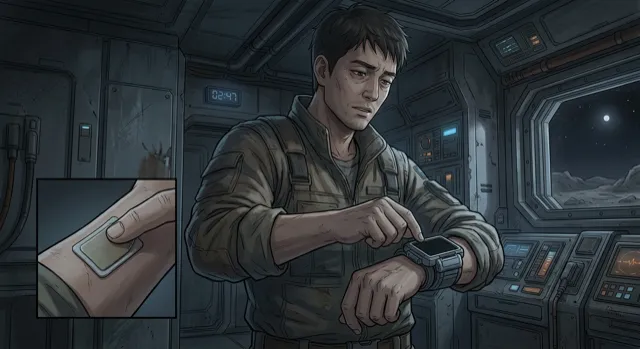
He looked down at his own wrist. The recognition chip implanted beneath the skin gave off a faint green glow. His information was stored there too. Kang Ihyeon. Onset date: age 41. Time remaining: 1 year, 7 months, 3 days. Another day had passed. Just as Seonu had said, his time was finite. But now the meaning of that time had changed entirely. Where before it had been a countdown to accepting a fate handed down to him, now it was a time limit — a deadline he had to fight against to dig out the truth.
When he reached home, Ihyeon went straight to his workroom the moment he stepped through the door. He powered on his aging personal server — a small refuge he had been building privately for years to slip past the LCP Consortium's surveillance net. He encrypted the data-discrepancy patterns he had uncovered, the records of the Pyeongsan Institute, and the information on the GRK-7 gene marker, and buried them deep within the server. It was a will and a piece of evidence left to the digital world, so that even if he vanished, someone might find it.
With the work done, he paused to catch his breath. What was he to do now? Walking into Sublevel 7 was walking into the tiger's den on his own two feet. And yet it was also an opportunity. The 'sensitive data that existed in analog form alone,' as Seonu had put it. Perhaps there, the starting point of every manipulation — the original sin that no one had ever dared to digitize — lay sleeping.
Just then, a small notification window blinked on the terminal screen of his encrypted personal server. An attempted connection from outside. Ihyeon's heart plunged to the floor once more. Had he been traced already? But the kind of alert was different. This was no ordinary hacking attempt. Like a guest who knocks at the door knowing the exact password, it was an anonymous message that had come in through an established protocol.
With trembling hands, he opened the message. A single line was written there.
[The chronicle of the rats did not end at Pyeongsan.]
The anonymous message tormented him all night, lodged like a shard driven into his mind. [The chronicle of the rats did not end at Pyeongsan.] The next day, the descent of the elevator toward Sublevel 7 felt as cold as being lowered into a coffin. When the door of the special archive opened, the smell of compressed time washed over him. Dust and ozone, and the scent of old magnetic tape. This was the womb where every prophecy had been born, and the tomb where countless truths lay buried.
As Seonu had instructed, he began inspecting the physical condition of the first-generation original tapes. But his eyes were scanning beyond the official inventory. 'After Pyeongsan.' A project that had failed, or been discarded, or deliberately forgotten. Digging through the system's architecture for days and nights, he recalled the name of a project he had found — one recorded in no official history. The 'Hwaseong Project.'
In the deepest recess of the archive, inside a cabinet labeled 'Data Value Undetermined,' he found several dust-covered tape reels. The labels had faded, but he could faintly make out the letters 'HW-07.' The Hwaseong Project. With trembling hands, he loaded one of the tapes onto an old analog reader. The motor began to turn, letting out a strange whine.
What filled the screen was not the data of rats. It was human. The original records of illegal clinical trials conducted in the LCP Consortium's earliest days under the pretext of 'anonymous donors.' And at their center was the data of human beings who carried the GRK-7 gene marker. Their true onset dates. Age 38, age 42, age 39… the prediction model pointed to a single number. An average of 41.
Ihyeon held his breath. 41. The number that had bound him his whole life. The Consortium's founding families had discovered the 'curse of forty-one years' inscribed in their own genes. And to bury it, they had built a system. They diluted their curse into the statistics of ordinary people, and made the time they stole into their crown. His finger traced 41 in the empty air. A number branded onto him by a curse that had nothing to do with him.
He began searching for a way to transmit this data to the outside. This antiquated reader sat in a blind spot of the central surveillance grid. Summoning every scrap of his knowledge, he built an emergency route to link this obsolete equipment to the Consortium's public data broadcast system. A single chance. One that could undo everything—or destroy everything.
"So you found it after all."
Seonu's voice came from behind him. He was as still as a shadow, and there was no telling how long he had been standing there. In his hand was a small nerve paralyzer. The paralyzer in Seonu's grip gleamed cold and metallic, pressing Ihyeon toward his choice.
"I'll give you a chance too. Kang Ihyeon. Bury this truth, and I can change your number as well. Not 41, but 82. Live a long life inside a manufactured serenity. The truth is only painful, only chaos."
Ihyeon did not turn to face Seonu. His eyes stayed fixed on the EXECUTE prompt on the screen. His whole life he had walked toward a foretold death, inside a number the system had assigned him. Beyond the 82 years Seonu offered, he saw hundreds of millions of real hours locked away inside the system. He knew how sweet Seonu's offer was. But at the end of that sweetness lingered the bitterness of a lie that had trampled hundreds of millions of lives.
"Everyone… must live their own real time."
Ihyeon pressed the enter key. The data upload began. A truth that had slept for decades came pouring toward the heart of the system at the speed of light. A sharp, tearing screech rang out as the old reader head scraped across the magnetic tape.
For the first time, the smile vanished from Seonu's face.
"You fool—!"
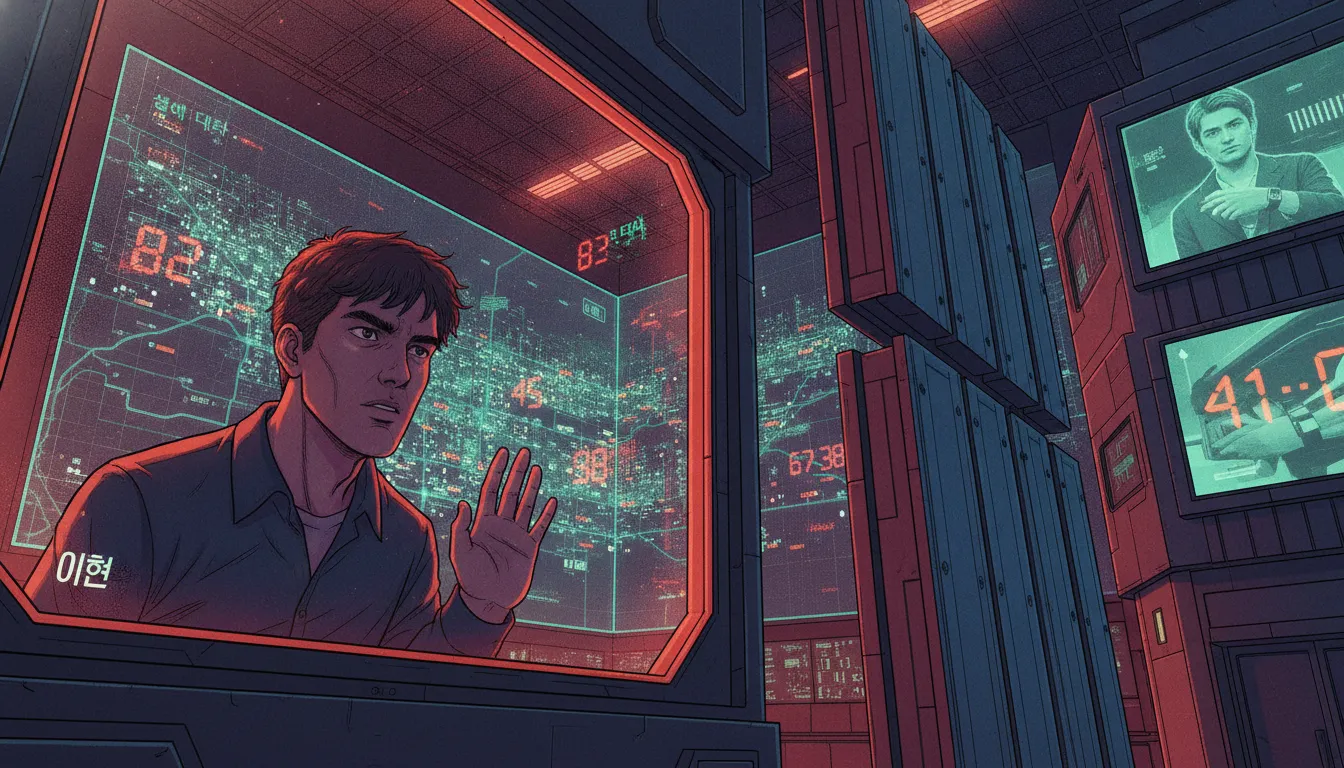
A shrill alarm shrieked through the entire archive. Massive firewalls began to descend. Ihyeon looked through the plate glass at the central control room. A vast hologram map visualizing the life data of the whole city. The billions of points that had glowed a steady, stable green began to flicker madly. 82 to 45, 67 to 38. On the ad screen floating on the wall of an enormous building, the model's number '91' glowing above his wrist turned to '43'—and in that instant the entire city went black, as though a power failure had swept through it. The plaza's hologram billboards all went dark at once, then began flickering nothing but meaningless error codes, endlessly.
Ihyeon felt a cold shock in his side, as if an ice pick had been driven into it. The paralyzer Seonu had fired. His legs gave way and he collapsed onto the cold floor. His vision blurred, and every sound receded into the distance. With the last of his strength, he lifted his wrist. The green light of the recognition chip implanted beneath his skin was blinking.
[Remaining time: 1 year, 7 months, 2 days.]
The numbers melted away into a blur. A moment later, in their place, a new number began to rise, faint and dim. Ihyeon never managed to make out what number it was. Beyond the receding alarm, he heard the slowing beat of his own heart. The floor against his cheek was hard, and cold.