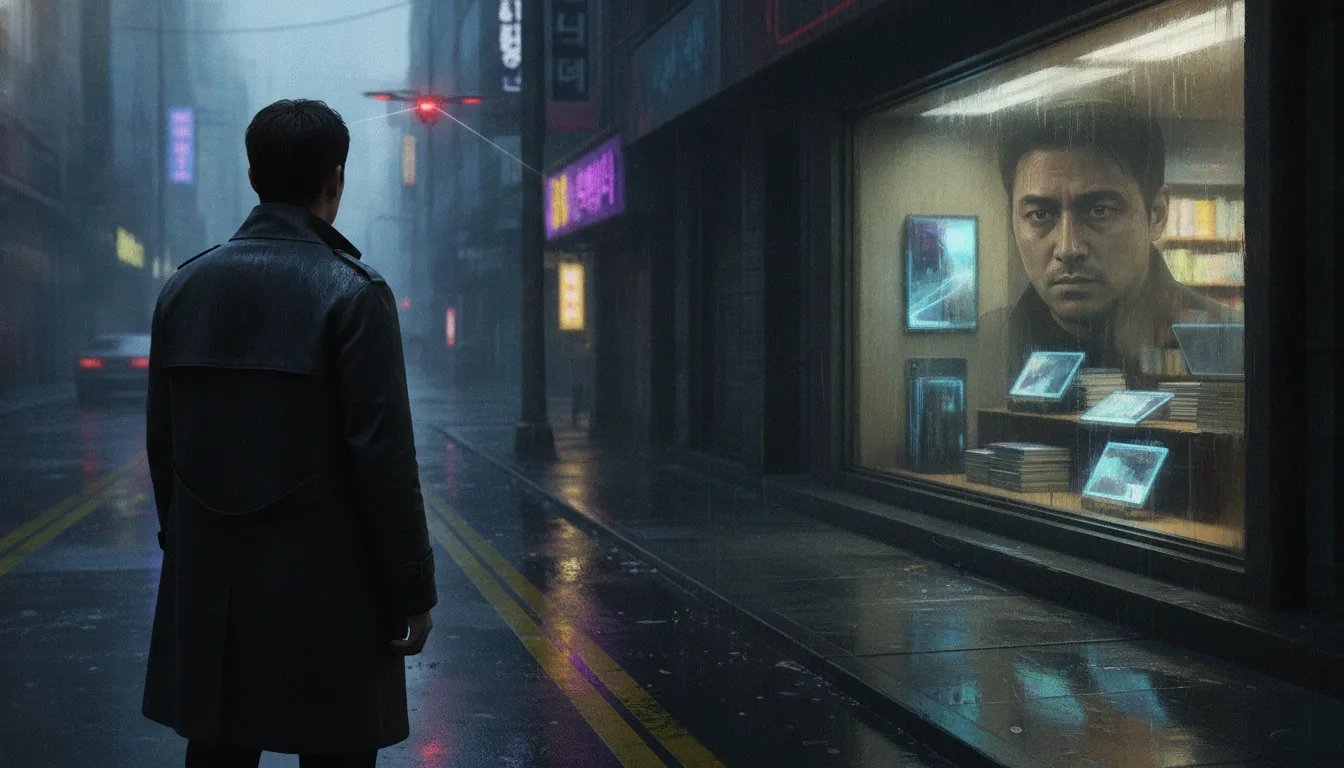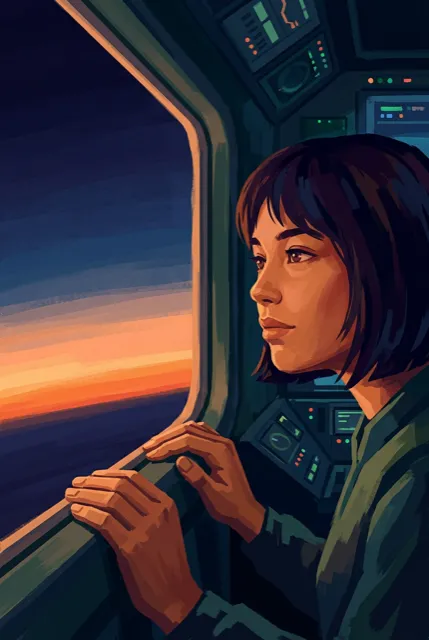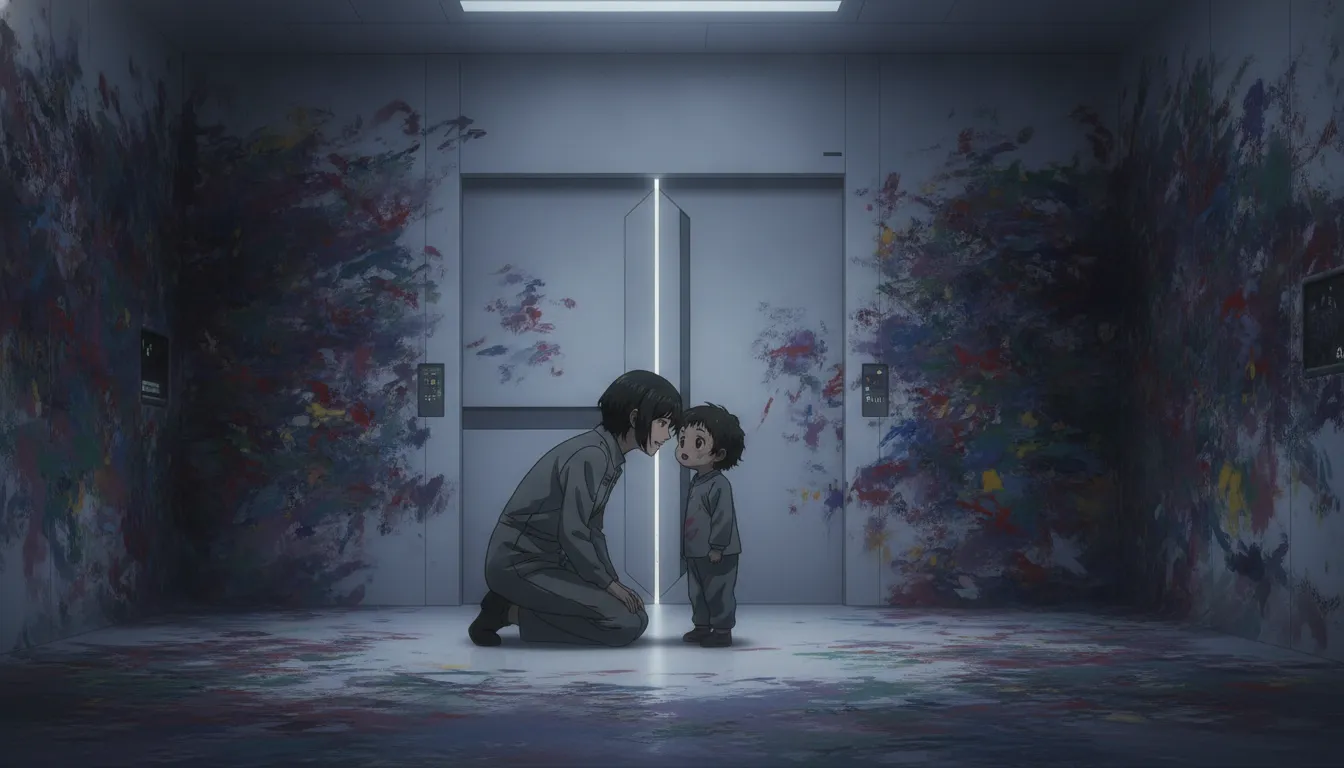
The child was drawing. The knuckles of the fingers gripping the crayon had gone white. A crimson line streaked across the datapad screen. The child mimicked the sound of the stroke with her mouth. Whoosh, whoosh. In that white room, the sound was everything. Sohyeon was watching the child's hand. The tip of the fourth finger was unusually plump. A minute asymmetry no one noticed—not even the child's own father. A small trait passed down from Sohyeon herself, lingering like a relic from the age before genetic standardization.
The door opened without a sound and a man came in. He set the datapad he was carrying down on the table. Glass met metal with a cold click. The child looked up, then sank back into her drawing. The man sat in the chair across from her and gave Sohyeon a slight bow of the head. His face bore no wrinkle, no mole. The smooth skin the standard genotype provided.
"Thank you for waiting."
His voice, like his face, was flat. Instead of answering, Sohyeon looked at the pad on the table. The man's name and title surfaced for a moment, then faded. National Health Assurance Bureau, Standard Conformity Counselor Jiwon. Through all three previous sessions, it had been the same face, the same voice.
"The final biometric analysis of Yuna has been completed."
Jiwon slid his own pad toward Sohyeon. Complex graphs and figures rose onto the screen.
"As you can see, most of the indicators fall within the permissible range. However, we found 17 genetic markers carrying the potential for malignant transformation. In particular, the probability of a P53 gene mutation registers 1,200% higher than in the standard type."
The numbers were highlighted in red. 1,200%. A figure engineered to provoke fear. Sohyeon turned away from it and looked at the child. She was drawing a green line now. Crimson and green mingled into a color like muddy water.
"I've already explained what this figure means. It means the incidence of 7 severe illnesses, cancer among them, is markedly higher than in the standard population group. Yuna's current Standard Conformity Index is 87.4%. That's the borderline where restrictions on social activity can begin to apply."
"Restrictions."
Sohyeon spoke for the first time. Her voice was hoarse.
As if he'd been waiting, Jiwon ticked off the items.
"Ineligible for admission to national and public educational institutions. Barred from all public programs premised on group activity. And most important, excluded from Grade 1 national health insurance. She'll be classified as Grade 4 Gamma."
"So because her odds of getting sick are high, you're telling her to pay more when she does."
"The system runs on risk, after all."
There was not a tremor in Jiwon's voice. He was merely stating a fact. The most immovable fact of this age. Statistics and probability. He held Sohyeon's gaze and went on.
"Mother, this is not a punishment. It's an opportunity. If you consent to the Standardization Edit here today, all of this risk converges to near zero. Yuna's P53 gene will be replaced with the most stable sequence. All 17 risk markers will be removed. The state supports the entire process. There is no cost. It's a social investment in your child's safe future."
Sohyeon fought back a laugh. A safe future. The safety they spoke of was synonymous with the standard. Standardized genes, standardized health, standardized faces. Faces as bland and predictable as Jiwon's. Sohyeon thought of her child's face. The face whose left eye narrowed a little when she smiled. The face whose right corner lifted slightly when she concentrated. A beauty of imbalance, the only one of its kind in the world. The Standardization Edit would erase all of it. Jiwon did not mention that, in the course of removing the risk markers, the small genes that gave rise to individuality would be 'corrected' along with them. Because that was a side effect of standardization—or its essential aim.
"If you do this edit, what happens to my child's face?"
For the first time a faint change crossed Jiwon's expression. The look of a question he hadn't anticipated.
"Her face? The skeletal structure and basic features won't change, of course. Only... the probability of 'defects' that can emerge during growth—asymmetry, skin trouble, pigmentation—drops significantly. She'll grow into a more harmonious, balanced appearance."
Defects. That was what he called the traits that made Sohyeon's daughter her own.
"To my eyes she's already harmonious and beautiful enough."
"A mother's eyes cannot serve as an objective measure."
Jiwon said it flatly. His finger swept across the pad and a simulation appeared on the screen. Based on a current photo of Yuna's face, the projected images of her 10 years from now—with the Standardization Edit and without it—hung side by side. On the left, the 'standard-type' Yuna was a pretty but unfamiliar child, with smooth skin and perfectly symmetrical features. On the right, the 'non-standard' Yuna had grown naturally out of the face she had now. A few small freckles had appeared on her left cheek, and the asymmetry of her smile had grown a little more pronounced. Sohyeon could see her daughter only in the child on the right.
"The child on the left isn't my daughter."
"Biologically, she is a more perfect version of your daughter."
"Being perfect and being mine are not the same thing."
The conversation ran along parallel lines. Jiwon spoke of statistics; Sohyeon spoke of the child's face. Jiwon worried about the child's 'life'; Sohyeon was trying to protect the child's 'self.' The air in the room grew heavy. Only the sound of the child's crayon broke the silence.
Jiwon let out a long breath. It was as if he were about to play his last card.
"Ma'am. You need to consider the social dimension. Yuna will soon be old enough for school. She'll make friends, begin forming relationships with the world. You know how blunt the world of children can be."
He paused for a moment, watching Sohyeon's reaction.
"Nonstandard children stand out. They stay sick longer from even a minor cold, and they get skin allergies more often. The other children perceive such a child as 'weak.' And they think of her as 'different.'"
Jiwon's gaze turned toward Yuna, who was drawing.
"Have you, by any chance, ever heard the phrase 'the seventh finger'?"
Sohyeon felt her heart drop through the floor. She had heard it. It was slang among children, used to mock the nonstandard ones. It meant a superfluous, deformed thing—something a normal hand does not have.
"Children are cruel. They seek out what makes someone different from them, and they brand her with it. The small mole on Yuna's face, the way her smile differs from others', a body prone to illness. Any of it could become 'the seventh finger.' What I'm saying is that your choice could make your child a target of ridicule for the rest of her life. If you love her, you must look at the world she'll have to live in. Not at your convictions."
It was not persuasion but a threat. It was the violence of the world, wrapped in a soft, reasonable voice. Sohyeon bit her lip. She tasted blood. Jiwon pointed one last time at the consent pad lying in the center of the table.
"Today is the final opportunity for state-supported standardization. Once you walk out that door, Yuna will be officially registered as a 'nonstandard child.' It cannot be undone. For your child's future, I hope you'll make the wise decision."
Sohyeon's gaze moved between the signature line on the consent form and her daughter, who sat in the corner of the room absorbed in her own world, drawing. The child was holding up the picture she had just finished, beaming. Crimson and green wildly intermingled—a chaotic picture, but one no one else could imitate. Over that picture, the child's asymmetrical smile overlapped.
Sohyeon took her child's hand. She felt the plump little cushion at the tip of the fourth finger against her palm. A living, warm defect. Sohyeon gripped the hand tight, as if refusing to let that warmth slip away. And with her other hand, she pushed the consent pad on the table back toward Jiwon. The sound of glass sliding across metal rang out longer and sharper than it had a moment before.
"My daughter,"
Sohyeon began. Her voice was no longer choked. It was firm and still.
"is not a bundle of numbers. Nor is she a subject of probabilities. This child is just—Yuna."
Jiwon stared at Sohyeon without a word. His face was as flat as ever, but his eyes had turned faintly colder. Instead of showing emotion, he lifted his datapad. A few taps. A low, brief electronic tone sounded in the room. Confirmed. Complete. Registered.
"I respect your choice, ma'am."
He said he respected it, but his voice sounded like a judge pronouncing a death sentence.
"Miss Kim Yuna, the nonstandard child registration procedure is complete. From this point on, a 'Gamma Grade' identification code will be permanently recorded on Yuna's citizen ID. This record cannot be deleted or altered until Yuna, after reaching adulthood, undergoes standardization at her own expense to raise her conformity index above 95%."
He rose from his seat. It meant there was nothing left to discuss. From beginning to end, his movements held not a trace of hesitation or wasted motion. It was a perfectly standardized gesture.
"The state and society do not compel the choices of the individual. We merely manage the potential risk that such a choice may pose to the community. I hope Yuna grows up healthy and safe."
The final words sounded like a curse without malice. Sohyeon did not answer. She simply took her daughter's hand and stood. Yuna held up her picture and shouted proudly.
"Mommy, look at this! It's a rainbow monster!"
A blob of jumbled colors filled the screen. Sohyeon lowered herself to the child's eye level and whispered. "That's the coolest monster in the whole world." As she said it, behind her she heard Jiwon leaving the room. The door closed, and the room sank once more into a perfect white silence. But that silence was not like the one at the start. It was a silence with an irreversible weight—the silence after everything has been decided.
Sohyeon led Yuna out of the counseling room. The corridor was the same corridor as when they had come in, yet everything felt different. The humidity in the air, the color of the lighting, even the material of the floor that swallowed their footsteps—all of it seemed to push them away as alien things. At the end of the corridor, before the automatic door, a man was pacing. It was Yuna's father, Sohyeon's husband, Minjun."]}
He, too, belonged to the generation that had reaped the benefits of the standard genotype. Like Jiwon, he had smooth skin and well-balanced features, yet on his face a faint wrinkle of anxiety—one the system had never managed to erase—was etched. The moment he saw Sohyeon and Yuna, he came toward them. His gaze skimmed past Sohyeon's face and went straight to Yuna, as though searching the child's face for the brand of 'nonstandard.'
"How did it go?"
Minjun's voice was low and urgent.
"You signed, didn't you? Of course you did. It's the only way—for Yuna's sake."
Instead of answering, Sohyeon looked at Minjun. In his eyes she saw the same kind of logic she had seen in Jiwon's. A rationality built on fear. A hunger for control that went by the name of love. That was what moved Minjun.
"Honey?"
Unable to bear Sohyeon's silence, Minjun pressed her. Yuna tugged at her father's sleeve and held up the datapad.
"Daddy, rainbow monster!"
Minjun didn't spare the child's drawing so much as a glance. Every nerve in him was fixed on Sohyeon's mouth. Slowly, she shook her head.
That small motion drained the blood from Minjun's face. His lips trembled.
"You didn't? Are you—out of your mind? Do you have any idea what you just heard in there? Do you really not understand how our Yuna is going to be treated from now on?"
His voice rose. A few people passing through the corridor threw glances their way. Woven into those looks was wariness, and a trace of contempt. The typical way people looked at a nonstandard child and its parents. Conscious of the eyes around him, Minjun lowered his voice, but his anger only sharpened.
"Because of that useless stubbornness of yours! Because of some sentiment from a worn-out age, you've decided to ruin our child's life? The seventh finger! That's what people are going to call our Yuna! Because of you, my daughter is going to be pointed at for the rest of her life!"
'My daughter.' He had clearly said 'my daughter.' But the words carried a meaning utterly different from the 'my daughter' Sohyeon spoke. To Minjun, a daughter was a possession to be protected and managed, and her worth was decided by how well she conformed to the social standard.
"Yuna is not a child to be pointed at."
Sohyeon said it coldly.
"It's people like you who make her one."
"What?"
"The eyes that see Yuna's difference as a defect, that go looking for a brand on a child's face. That's what turns her into a monster. Not the system—you."
The words became a knife and flew into the space between them. Minjun looked at her with a wounded expression. As if he couldn't understand—or didn't want to—he muttered,
"I just… I only wanted Yuna to live an ordinary life, like the other kids. Without getting sick, without being discriminated against. Is that wrong, for a father to want?"
"What even is ordinary?"
Sohyeon shot back. Her gaze took in her husband's smooth face, the flawless corridor walls behind him, this entire world where everything had been standardized.
"Everyone wearing the same face, thinking the same thoughts, aging according to a fixed set of odds? I don't want Yuna to live like that. If freckles come, let them come; if her face goes lopsided when she laughs, let it. When she hurts I'll cry with her, and when she heals I'll laugh with her. That's everything I have to give her."
The distance between them was a single step, yet the worlds they stood in were entirely different. Sensing, perhaps, the cold air the grown-ups' words had stirred up, Yuna lowered the hand that had been holding out her drawing and hid behind Sohyeon's leg. In a small voice, the child asked,
"Mommy, are we going home now?"
That innocent question broke the last of Minjun's composure. He gave a hollow laugh and took a step back.
"Home, huh… You think that 'home' you've built will be a safe fence around Yuna? The world isn't that easy, Sohyeon. You're going to regret this soon. The day will come—it's bound to—when you realize it wasn't your convictions but this world that was right."
With those words, Minjun turned away. The sight of his back was that of a perfect stranger, someone Sohyeon had never seen before. He disappeared down the far end of the corridor without once looking back at Yuna. Left behind in the cold air were only Sohyeon, Yuna clutching her mother's leg, and the drawing of the rainbow monster in the child's hand.
On the way home, the car was thick with a heavy silence. Minjun held the wheel, but he drove staring straight ahead, as though Sohyeon and Yuna weren't there at all. His standardized face was a mask from which no emotion could be read. In the back seat, Yuna—perhaps sensing the mood between her mother and father—only gazed quietly out the window. The datapad still lay on her lap. The monster of mingled colors glowed precariously.
After that day, the house became a quiet battlefield. Minjun treated Yuna even more tenderly than before, but hidden within that tenderness was always a sharp thorn. If the child so much as gave a small cough, he would shoot Sohyeon a look, as though he'd been waiting for it. On the day a tiny pimple rose on the child's cheek, he came home laden with disinfectant and ointment, making a show of it. Every one of his actions was a soundless accusation. 'See? I warned you. This is all your fault.'
Time passed, and Yuna reached the age for kindergarten. The public institutions refused her, of course. After asking everywhere she could, Sohyeon at last found a small private school that took in nonstandard children like her own. On the first morning, Sohyeon stood at the kindergarten playground, holding Yuna's hand. The children there were each their own. One child's skin was uneven in color; another walked with a slight hitch in her step. A little island of children who fell outside the standard mold. And yet this place, too, was the world in miniature.
A child came up to Yuna, who was building a sandcastle, and asked her a question.
"Why does your face go all crooked when you smile?"
The child asked it without malice, out of pure curiosity. Yuna, not grasping what the words meant, stared back blankly. In that instant the other children's eyes all swung toward her. Sohyeon felt her heart turn to ice. Jiwon's voice, Minjun's curse, rang in her ears like a phantom sound. 'The seventh finger.'
Sohyeon held her breath and stepped toward Yuna. What was she supposed to do. Should she gather the child up and leave this place? Or was she meant to be angry on her behalf? Just as Sohyeon opened her mouth to speak, Yuna touched her own face with her hand, then broke into a wide grin at the child who had asked. The left eye crinkled smaller, the right corner of the mouth lifted higher — a lopsided smile that was the only one of its kind in all the world.
"My face dances when I smile!"
Yuna proclaimed it proudly. The children tilted their heads as if to say, what on earth is she talking about. Unbothered, Yuna scrunched up her face and smiled again. It really did look as though the muscles of her face were dancing away, merrily, each to its own tune. At that, the child who had asked began screwing up his own face this way and that, marveling at it. "Mine won't dance, though?" A few of the children burst into peals of laughter and started copying Yuna's 'dancing face.'
Sohyeon stood rooted where she was, unable to move. Her eyes stung with tears, but she did not cry. The child was finding her own way. In a world that turned difference into a thing to be mocked, she was learning to turn her own difference into play. It was not something Sohyeon had taught her. It was the moment Yuna herself, Yuna's own singularity, had risen up to protect her.
That night, Sohyeon lay down beside the sleeping Yuna. The small sound of her breathing filled the room. On the child's face, faint freckles had begun to surface now, like stars. Sohyeon quietly reached out and took her daughter's hand. The little cushion of flesh at the tip of the fourth finger. A small inheritance passed down from herself — the thing the world called a defect. Sohyeon did not regret it. Minjun might have been right. The world would be cruel to Yuna. The child would be wounded and knocked down more times than she could count.
But at the same time, the child would dance in her own way, understand the world in her own language, and rise again by her own strength. Sohyeon resolved to believe in every one of the moments her daughter would go on to live. That rainbow monster called life, the one no probability or statistic could ever predict.
Sohyeon ran her own finger, very slowly, one more time, over that unusually plump flesh at the tip of her daughter's fourth finger.