The terminal on his wrist gave a faint vibration. It wasn't a warning. Not the flashing red or orange of an emergency signal, but a soft pale-green light pulsing at a steady interval. Fifteen years ago today. Minjun didn't need to look at the terminal to know what the notification meant. A day the system called an "anniversary" — but for him, it was closer to a brand.
He rose slowly. The air in the bedroom was perfectly controlled. Temperature 22.5 degrees, humidity 44 percent. The ceiling ventilation system ran around the clock, filtering out fine dust and allergens, releasing a low-frequency white noise to maintain an environment optimized for stable heart rhythm. It was the "High-Risk Group Standard Residential Environment" recommended by the National Quantum Biometric Institute (NQBI).
Minjun went out to the living room. In the kitchen, the nutrient dispenser was extruding breakfast. A thick, pale-gray liquid. Sodium, sugar, and caffeine completely removed, composed of nothing but the trace elements needed to keep the heart-brain synchronization rate stable. He had eaten the same thing every morning for over ten years. It was meant to block the unpredictable effects that the sensory stimulation of taste could have on the sympathetic nervous system. Everything was by the manual.
Outside the window, the sky was overcast. He walked over and looked out. A safety lock kept the window from opening more than 15 degrees. Through that narrow gap, the outside air carried a smell different from the filtered air indoors. Wet earth, a faint trace of exhaust. Smells the system classified as "contaminants." He breathed them in for a moment. They resembled the smell of the day, fifteen years ago, when he had run across a dust-blown school field.
That day, Minjun had been the first to break the finish line in the elementary school relay team tryouts. His breath had caught in his throat, his heart pounding as if it would crack his ribs. It was the first time he'd ever felt euphoria in the violent sensations his own body could produce. But the next day, the P.E. teacher didn't call for him. Instead, his homeroom teacher took him to the counseling office. On the desk lay a thin data sheet from NQBI.
"Heart-brain quantum synchronization signal unstable. High probability of acute cardiac arrest onset during high-intensity physical activity."
That was the first line ever drawn across his life. Countless more lines followed after. No running. No ball sports. No caffeinated drinks. Films and music with large swings of emotional intensity were added to the list of recommendations, too. His life filled up with a list of things he must not do. The system called it "protection" — cutting-edge medical welfare that warned him of danger in advance and helped him steer clear of it. Everyone lived safely, wrapped in that same benevolence.
The terminal vibrated once more. This time it wasn't pale green. It was the sky-blue light that signaled an incoming message. He lit up the terminal screen. The sender was the NQBI Data Management Division.
[Subject: Final Stability Protocol v4.0 — Deployment Notice]
[Recipient: Seo Minjun (Unique Identifier QR7-2049-881)]
[This protocol constitutes the final management guidelines to be applied over the next 12 months, during which the subject's risk curve will reach its peak. It supersedes the existing 'Daily Avoidance Manual,' and all recommendations must be strictly observed to maximize survival probability. Please review the attached file.]
Minjun swallowed hard. The word "final" caught his eye. His risk curve had risen gently since birth, cresting in his late twenties. The doctor had explained it to him many times — that if he could just get through this period safely, the curve would begin to fall again, that all he had to do was be careful until then. Now that time had come.
He took a deep breath and opened the attachment. Guidelines running hundreds of pages filled the screen. They were far more detailed and relentless than the previous manual.
- Recommended heart rate: Maintain 60–85 beats per minute. Sustained readings above 90 for 5 minutes trigger an automatic alert and guardian notification.
- Recommended travel radius: Within 5 kilometers of primary residence. Avoidance of peak congestion hours mandatory when using public transportation.
- Recommended diet: Use of NQBI-certified nutrition dispensers mandatory. Consumption of outside food strictly prohibited.
- Recommended media list: Viewing permitted only for works on the "Green List" curated by the NQBI Psychological Stability Committee. (e.g., the documentaries The Movement of Glaciers, The Ecology of Moss)
- Prohibited activities: driving; personal operation of any vehicle, including bicycles; ascending more than one flight of stairs at speed; any situation involving argument with others or emotional agitation…
The list went on without end. It read less like guidance for living than an operating manual for a life-support device. Minjun's finger stopped mid-scroll. His eyes caught on a single sentence. "To prevent unexpected drops in synchronization rate, it is recommended that all stimuli likely to trigger recollection of past vigorous physical activity be removed."
He looked up at the closet. Deep inside it, in a box, sat a worn pair of running shoes. He had worn them exactly once, fifteen years ago, at a relay team qualifier. The soles were barely worn down, but the sides had yellowed with old dust and dirt. The system, it seemed, now meant to manage even his memories.
Just then, a call came in. The name on the screen read "Sis." He hesitated a moment, then pressed the button to answer.
"Minjun, did you get the protocol?"
Jihye's voice came through the receiver calm and steady. She was a researcher at NQBI — and also, in her way, part of the system that managed him.
"Just now."
"Good. I looked it over beforehand — it's really well put together. Just one more year, exactly one year of following it, that's all. Then your synchronization curve will settle into a stable phase. I know it's hard, but let's hang in there a little longer. Okay?"
His sister's voice carried genuine concern. Minjun knew that. But that concern felt like iron bars.
"This… this isn't living."
The words slipped out of him, small and quiet.
"What are you talking about? This is what's keeping you alive. There are people who'd want this kind of care and can't get it. You're the lucky one."
"Lucky?"
"Of course. What a stroke of luck it is, knowing danger before it comes. People in the old days were defenseless against illnesses that could strike at any moment. Not us. The system is watching over you."
The system. Minjun repeated the word silently to himself. His sister trusted the system. She believed its data and its predictions were as good as truth. He couldn't say that belief was wrong. For decades the system's predictions had shown 99.7 percent accuracy, and had saved countless lives.
"It's just... sometimes I wonder. What if the prediction is wrong? What if I'm the one in that 0.3 percent?"
"Don't think like that. Anxiety is the worst thing for your synchronization rate. It's right there in the manual. Think positive. Just follow the protocol without thinking about anything else. That's the safest way."
Without thinking about anything else. Minjun wanted to hang up.
"Noona."
"Yes, go ahead."
"Back then, 15 years ago. If I'd kept running, what would have happened?"
A brief silence fell on the other end of the line. Jihye sighed.
"Minjun. Don't say pointless things. You're here right now because you stopped back then."
"If I'd just died then...."
"Seo Minjun!"
Jihye's voice turned sharp. For the first time, a crack of emotion showed through it.
"Don't talk like that. It's all for your own good. Understand? I'll stop by this evening."
The call cut off one-sidedly. The terminal screen was lit once more with the first page of the Final Stability Protocol. Minjun glared at the screen for a long while. 'Maximize survival probability.' The phrase seemed to mock him. A life erased in the present for the sake of a probability. Time spent giving up being alive in order not to die.
He rose from his seat. Then he walked to the closet. He took out a box and set a pair of worn sneakers down at his feet. Shoes with 15 years of dust settled on them. He bent at the waist and took hold of the laces. Then he looked back at the terminal.
The Final Protocol file sat open on the screen. He moved his finger and pressed down on the file icon. A small menu appeared on the screen. Share, Rename, and Delete.
Minjun's finger hovered over the 'Delete' button for a moment. His fingertip trembled. This was not a simple file deletion. It meant severing ties with the world that had bound him for the past 15 years. It was a rebellion against the system, a gamble staked on his own fate.
The screen asked. [Do you want to permanently delete this file? This action cannot be undone.]
He looked out the window. A breeze slipped in through the 15-degree gap and brushed his cheek. Unfiltered air — the real world's air.
He closed his eyes. Then he pressed the button. The protocol file vanished from the screen. Only an empty wallpaper remained on the terminal. He walked to the front door and opened it.
The corridor apartment's cold cement floor felt cool against his bare feet. For the first time in 15 years, he stood in a space beyond the system's control. He passed the elevator and headed for the emergency stairwell. The protocol recommended using the elevator, but he chose the forbidden act on purpose. With each step down, his knee joints creaked—the scream of muscles atrophied from disuse. His terminal stayed silent. For now, everything was still within the recommended heart-rate range.
Stepping out through the ground-floor entrance, the noise of the gray city rushed over him. Cars glided along the road with a low hum, distant cargo drones sliced through the sky overhead, and construction noise drifted in from somewhere far off. It was a flood of living sound, incomparable to the controlled white noise indoors. He closed his eyes for a moment and let himself feel that irregular wave of sound. It was dizzying, but at the same time, the sensation of being alive struck him full in the mind.
He sat on a bench in the apartment complex and put on his old sneakers. The worn leather pressed unfamiliarly against the top of his foot. He tightened the laces firmly. It was a sensation his feet still remembered. Faintly, the tension of that moment 15 years ago, when he'd kicked off through the dust, came back to life. He stood up. Where should he go now? There was no destination. He simply had to run.
At first he walked slowly. As he widened his stride, the terminal buzzed lightly and lit up pale green. 'Stable physical activity. Maintain current state.' The system still believed he was under its control. Minjun gave a short laugh. He picked up the pace a little and broke into a jog. His joints still creaked, but bit by bit they began to loosen, like a machine slowly being oiled.
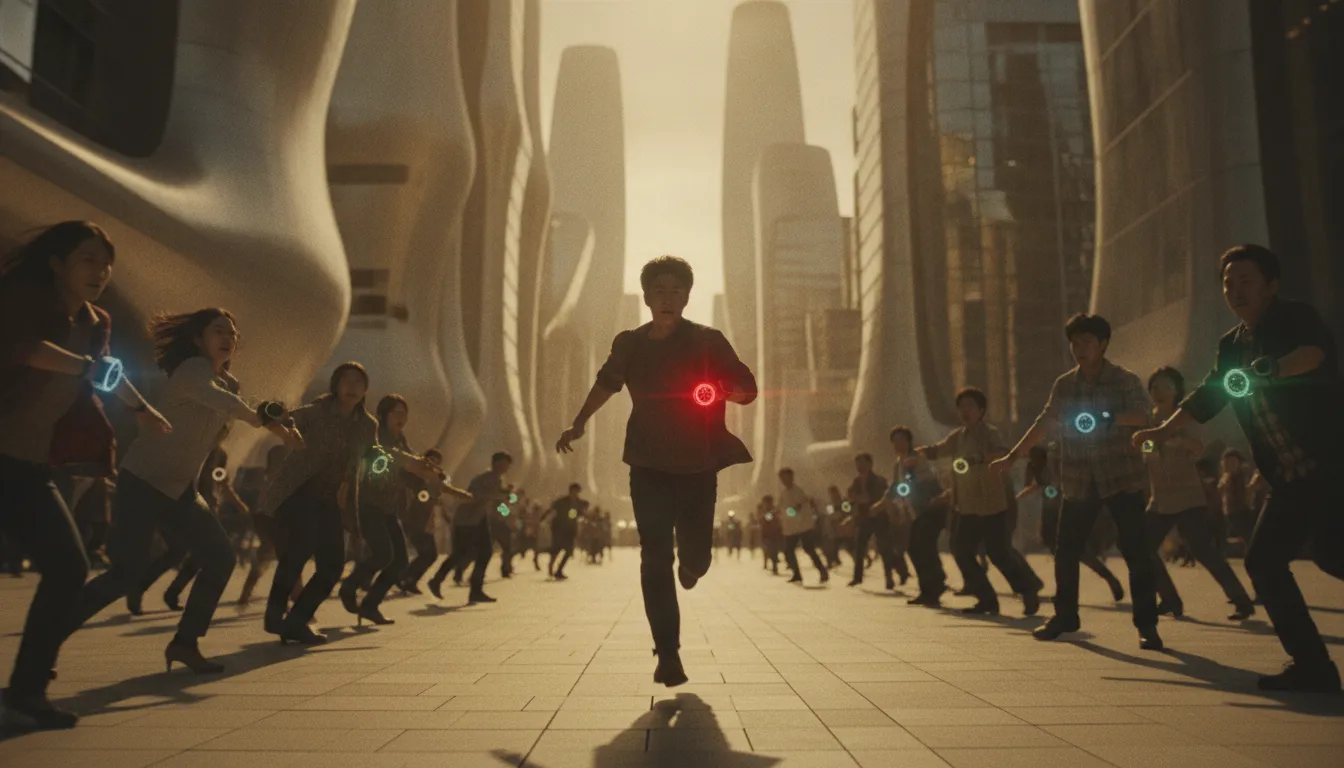
The terminal's light turned orange. 'Warning: heart rate rising. 95 beats per minute. Reduce your speed.' The alarm hadn't sounded yet—not until he held on for 5 minutes. Minjun paid it no mind. He widened his stride further. The jog became a run. The wind brushing his cheeks was cold. Unfiltered air drove deep into his lungs. A cough burst out of him, but he didn't stop.
His heart screamed. It was like a bird thrashing wildly inside his ribcage. It hurt. But the exhilaration he'd felt 15 years ago rose up over the surface of the pain like a film of oil. He ran faster. Now the terminal blazed crimson and began shrieking a sharp alarm. 'Danger! Heart rate has exceeded the critical threshold! Cease activity immediately! Relevant information has been transmitted to your guardian!'
The blaring alarm drew the eyes of the people around him. They stepped aside and avoided him as though looking at a plague victim. On their wrists too, terminals glowed green or sky-blue, each announcing its owner's status. A red light was a symbol of catastrophe. Minjun ran straight through their stares, a mixture of pity and contempt. For the first time, he felt not like a dropout of the system, but like one single human being, running by his own will.
The burning pain in his lungs reached its peak just as he arrived at the bike path along the Han River. His legs gave out, and he sank straight to the ground. He gasped for breath, clutching his chest. The device was still shrieking its emergency alarm. Soon his sister would call, or one of NQBI's automatic emergency drones would come flying in. But something was strange. His heart felt like it would burst, yet his mind had never been clearer. The sensation of being alive overpowered him more fiercely than the fear of death.
Just then, someone stopped beside him. A shadow fell over him. Minjun looked up, still gasping. It was a woman around his own age. She wore workout clothes, but her wrist was bare — nothing on it at all. She glanced down, indifferent, at Minjun's device blaring its warning, then held out a bottle of water.
"First time?"
The woman's voice was quiet, but it cut clearly through the noise around them. Minjun eyed her warily. She grinned and perched herself on the railing of the bike path.
"If you let it keep ringing like that, they'll catch you soon enough. The location signal refreshes every five minutes. Though usually the drone gets here before that."
She said it as flatly as if reciting a weather forecast. Minjun was bewildered. Who was this woman? Why was she trying to help him?
"Wh— who are you?"
"Just someone passing by. Every now and then there's someone running that loud. Most of them get caught on their very first sprint, though."
She said the word "sprint" as though it carried some special meaning. She glanced up at the sky once, then went on.
"So, how does it feel — being granted speed? Like you're about to die, but you don't. At least, not yet."
At that moment, the faint sound of a siren reached them from far off. The woman frowned. "Faster than I expected. Your risk grade must be pretty high." She rose to her feet and held out a hand to Minjun. "Keep sitting here, and you'll be dragged off in the name of 'protection' — and after that, you won't even think of stepping outside your door again. The choice is yours, though."
Minjun looked back and forth between the woman's hand and the approaching wail of the siren. The device was still screaming that his vital signs were in the danger zone, that he needed to stabilize. His sister's worried face rose in his mind. So did the safe future the system had promised him. But he lifted his head. In the woman's eyes, he saw the same kind of thirst that lived in his own.
Just as he reached for the woman's hand, a white NQBI emergency vehicle screeched to a halt in front of them. The door flew open, and his sister Jihye leapt out, her face pale.
"Seo Minjun! What do you think you're doing!"
Jihye's voice trembled with anger and fear. She grabbed Minjun's arm roughly. Her gaze shifted to the woman standing beside him, and hostility flashed instantly into her eyes.
"You... you're an 'Unplugged.' What did you do to my brother?"
The nameless woman only shrugged at Jihye. "I didn't do anything. Your brother made his own choice. His own speed."
Minjun wavered between the arm Jihye held fast and the woman's hand still outstretched toward him. One side was the world trying to save him. The other was the world he wanted to live in. His heart was still beating dangerously, but for the first time, he understood whose pulse it was.
"He made his own choice?"
Jihye echoed, incredulous. Her eyes stayed fixed on the terminal at Minjun's wrist, still glowing red.
"You call this a choice? The system's saying Minjun's heart is about to stop! This is suicide!"
"The system speaks in probabilities,"
the woman replied evenly.
"But a heartbeat isn't a probability."
The words rippled through Minjun's chest. A heartbeat isn't a probability. For fifteen years he had thought of his own body as a set of data, a collection of variables to be managed. Beats per minute. Brainwave synchrony rate. Blood oxygen saturation. Numbers had defined him, had drawn the radius of his life. But now, this violent pounding thrashing wild inside his ribs was not a number. It was pain and it was ecstasy, it was terror and it was life itself, vivid and alive.
He looked at his sister's face. Tear-streaked, desperate. Someone who loved him enough, feared losing him enough, to want to cage him. That love was real, but it would never permit him the shape of life he wanted. He looked down at his arm, held fast in Jihye's grip. Then, slowly but with resolve, he pulled it free.
"Minjun...?"
Jihye's voice shook. For the first time, Minjun looked his sister straight in the eye.
"I'm sorry, noona. But this... this feels like being alive."
His voice came out ragged, tangled in labored breath, but it carried a firmness that, for the first time in fifteen years, was truly his. He no longer hesitated. He turned and took a step toward the nameless woman.
"Let's go."
The woman gave a short nod. She broke into a run first, and Minjun followed close behind. Behind them, Jihye screamed his name like a wail torn from her throat. NQBI agents spilled out of their vehicle and gave chase. Sirens closed in, shrill enough to split their eardrums.
"This way!"
the woman shouted, flinging herself toward the entrance of an old underground passage. The stairs were dark and damp — a space Protocol would have barred them from even approaching. Minjun wrung out the last of his strength and followed her down. They half ran, half stumbled down the steps, and the noise of the street above fell away as if by magic. Only their ragged breathing and the sound of water dripping down the damp walls filled the tunnel.
After running on for a long while, they emerged from the far exit into an entirely different world. They had come out into an old, tangled market alley. It seemed to be a zone beyond the system's reach — no terminals glinted on anyone's wrist. Instead of delivery drones slicing through the air, people carried their own goods by hand, and in place of regulated silence, the air was thick with blaring music, the clamor of haggling, and the mingled smells of savory oil and spice that struck the nose all at once.
Minjun leaned back against the wall, feeling dizzy. The device on his wrist had stopped beeping — the tracking signal must have dropped. Only the red light kept blinking, an ugly little pulse. The woman watched him for a moment, then went to a nearby stall and bought two steaming skewers, holding one out to him.
“Eat first. It won't taste like nutrient supplement, I promise you that.”
Minjun hesitated before taking the skewer. Food from outside, uncertified by the NQBI. A hazardous substance that might trigger some unpredictable reaction in his body. He swallowed hard and took a bite. It was salty, spicy, hot — a jolt so intense it felt like every sensory cell on his tongue was screaming at once. But strangely, the sensation wasn't unpleasant. If anything, it felt like some hollow part of him was finally being filled.
He wolfed down the rest of the skewer in a rush. Watching him, the woman gave a faint smile.
“My name's Seorin.”
“I'm Minjun.”
A brief exchange of names passed between them. What would happen now? Where should he even go? He knew nothing. His future no longer existed on any of the NQBI's risk curves. In place of survival-probability data, there stretched only infinite uncertainty. It was terrifying — and at the same time, it made his heart beat again.
Seorin pointed toward the end of the alley.
“Past that, you get to places the system's surveillance barely reaches. Can't promise it's safe, though.”
Safe. Minjun turned the word over in his mind. He had thrown safety away to come here. He started walking again, following Seorin. The rough texture of the asphalt through his worn sneaker soles felt unfamiliar. His heart was still beating a little fast, but now it no longer felt like a danger signal — it felt like proof he was alive. He drew the murky air of the gray city deep into his lungs. Air thick with the exhaust, dust, and mingled human smells the system had once classified as 'contaminants.' For the first time in his life, he breathed on his own will.