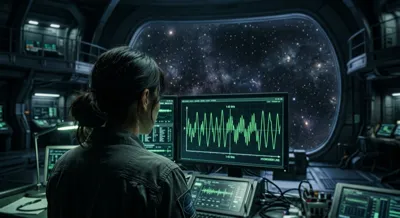
The observatory stood at 4,200 meters above sea level. At night the stars poured down. Poured — that was the right word. There were so many stars that the sky wasn't black. It was gray. The light of the stars overlapped until the sky itself seemed to glow. Sua looked at that sky through the observation-room window. Frost had gathered on the glass. If you scraped the frost with a finger, the stars outside came into sharper focus. Sua didn't scrape the frost. She hated when they sharpened. It was a sky she had been watching for 3 years now. When she came here 3 years ago, that sky had been beautiful. Sua had come here to write her doctoral dissertation. Hydrogen-line observation. A study of intergalactic gas distribution. Ordinary research. The work of gathering hydrogen-line data used to estimate the age of the universe. The work of counting stars. It had been beautiful work. Now it was different. Not beautiful — as if something were looking down.
A waveform hovered on the monitor. A green line rose and fell at regular intervals. Frequency 1.42 gigahertz. The hydrogen line. The most common frequency in the universe. But this waveform was not the hydrogen line. It was a modulation pattern riding on top of the hydrogen line. Someone was using the hydrogen line as a carrier to send another signal. Sua had been analyzing that pattern for 3 months now. At first she thought it was noise. She thought it was a machine error. She replaced the equipment and measured again. The same pattern came out. Sua tried feeding the pattern into a brainwave database. It was a joke. A surely-not sort of impulse. When a match rate of 97.3 percent came up on the screen, Sua couldn't get up from her chair.
"Pulling another all-nighter?"
Gijun opened the observation-room door and came in. He had zipped his padded jacket up to his chin. His nose was frozen red. He held 2 paper cups. Coffee. The only warm thing at the observatory was coffee. Instant. 2 sugars. The way Gijun always made it. The heating shut off at 10 p.m. for lack of power. It was 2 a.m. now. The observation-room temperature was minus 3.
"Can't sleep."
"Because of the signal?"
"Because of the dream."
Gijun set the coffee on Sua's desk. Sua took the cup. It was warm. Sensation came back to her fingertips.
"That dream again?"
"Yeah."
"I had it too."
Sua looked at Gijun. His face was pale. Not only because of the observatory's ultraviolet light.
"What was it about?"
"The same. I'm looking through the telescope. And on the other side of the telescope, something is looking at me. Not eyes. It has no eyes. But it's looking. I feel its gaze."
Sua drank her coffee. The bitterness wrapped around her tongue.
"Jina had the same dream."
"Jina too?"
"Yesterday. The exact same dream. Something looking from the other side of the telescope."
Gijun dragged over a chair and sat. He looked at the monitor. The green waveform.
"Did the brainwave comparison come back?"
"It did."
Sua tapped the keyboard. The screen changed. Two waveforms were displayed side by side. The top one was the deep-space signal. The bottom one was a human brainwave. A brainwave from the REM stage of sleep.
"Match rate."
"97.3 percent."
Gijun looked at the screen. The two waveforms nearly overlapped. There was almost no gap between the top line and the bottom line. A difference about the thickness of a sheet of paper. 0.6 hertz.
"This isn't a coincidence."
"I wish it were a coincidence."
Sua couldn't take her eyes off the monitor. This signal had come from the direction of Cygnus. The distance to its source was 14 billion light-years. A distance that takes 14 billion years at the speed of light. The age of the universe is 13.8 billion years. This signal meant it had existed from just after the universe was born. From 13.7 billion years before humans appeared. From 9 billion years before the Earth formed. This signal came first. The human brainwave came later.
"Human brainwaves were in the universe before humans existed."
Gijun said. His voice was low.
"Humans copied it. Our brains were made to follow this signal."
"Or."
Sua said.
"We're the receivers for this signal."
The observation room fell quiet. Only the sound of the monitor's fan. A hum. A regular sound. Outside, wind blew. The wind at 4,200 meters above sea level. The observatory walls trembled faintly.
Sua took a document out of the drawer. The response protocol. The procedure for responding to a signal from an extraterrestrial intelligence, laid down by the International Astronomical Union. It was a protocol drawn up in 2031. It had never once been used. For 46 years it had lived only inside a file. The paper had yellowed. The edges had curled. The first time Sua pulled out this document was 2 weeks ago. It had been sitting at the very bottom of the file cabinet, buried under dust.
"The response-frequency calculation finishes tomorrow."
"So then we send it?"
"According to the protocol, we have to send it."
"Would the protocol have anticipated a situation like this?"
Sua looked at the document. Article 3. 'If judged to be an intelligent signal, send an acknowledgment of receipt.' An intelligent signal. Is this an intelligent signal. Was it sent by an intelligence. Or is the very structure of the universe the same as a brainwave. Is there even a difference between intelligence and structure.
Gijun stood up.
"I'm going to sleep."
"Sleep well."
"I hope I don't dream."
Gijun left. The door closed. His footsteps faded down the corridor. Sua listened until the sound of them was gone. She sat alone in the observation room. The green waveform on the monitor kept moving. Up and down. Regular. Like breathing. She counted its period. One rise and fall every 4.2 seconds. Identical to the cycle of human REM-sleep brainwaves. Sua's own breath came once every 4 seconds. She felt her breathing syncing to the waveform. She sped it up on purpose. 3 seconds. 2 seconds. But the moment she let her eyes settle back on the waveform, it slid back to 4.
Sua took out her headphones. There was a file that converted the signal into an audible frequency. She pressed play. Sound filled the headphones. A hum. A low hum. Then rising and falling. Something like the sound of waves. But it wasn't waves. It was slower than waves. Deeper than waves. It seemed to resonate inside her body. The feeling of bone ringing. Something vibrated behind her sternum. Sua closed her eyes.
Listening to it made her drowsy. It always did. When she listened to this sound she fell asleep. And she had that dream. Sua pulled off the headphones. Her hands were shaking. Whether from the cold or from fear, she couldn't tell.
4 a.m. Sua came out of the observation room and walked the corridor. The corridors of the observatory were narrow. Concrete walls. Every other fluorescent light was switched off. Power saving. Half the corridor was dark. Sua walked through the lit stretches and the dark ones by turns. Light. Dark. Light. Dark. Her footsteps echoed down the hall. The sound of slippers on concrete. There were 4 people at the observatory. Sua, Gijun, Jina, and Hyeonsu, who handled the equipment. Hyeonsu took no part in the signal analysis. Hyeonsu was the only one who didn't dream. Sua thought about what that meant. Only the ones who analyzed the signal dreamed. Only the ones who had concentrated on it. Only the ones whose reception had grown more sensitive.
She passed in front of Jina's room. Light was leaking out from under the door. Jina wasn't sleeping either. Sua knocked.
"Jina?"
No answer. Sua opened the door. Jina was sitting at her desk. She was staring at her laptop screen. A waveform was up on it. The same waveform. The deep-space signal.
"Jina."
Jina turned. Her eyes were red, bloodshot. The face of someone who hadn't slept in days.
"Sua."
"Why aren't you asleep?"
"If I fall asleep I dream that dream again."
Jina's voice trembled.
"I'm scared, Sua. In the dream it looks at me. But it has no eyes. It has no eyes and it looks at me. And when I look at it, it smiles. It has no mouth and it smiles. I just know it, by the feel of it. That it's smiling."
Sua put a hand on Jina's shoulder. Jina was holding a cup. A cup of water. The water was quivering. Because Jina's hand was shaking. Jina's shoulders were shaking.
"It's the same. It's the same for me."
"Is it normal for three people to have the same dream? Isn't it just because we're all in the same observatory listening to the same signal? Some kind of mass suggestion or something."
"It isn't normal, no."
"Is it the signal?"
Sua didn't answer. She couldn't. If she said it was the signal, the next question would come. Did she mean the signal was affecting our brains.
Sua left Jina's room. She went to her own. She lay down on the bed. She looked at the ceiling. The observatory's ceiling was concrete. There was a crack in it. The mark of water seeping through. Sua looked at the crack in the ceiling and then closed her eyes. She tried not to fall asleep. If she slept, she would dream. In the dream she would see it.
She fell asleep.
It was the dream. Sua was standing in front of a telescope. The telescope was pointed at the sky. She put her eye to the eyepiece. She saw stars. Between the stars there was darkness. That darkness moved. The darkness had no form. It had no size either. But it was there. Sua saw it.
It saw Sua too. Her spine went cold. She was inside a dream and yet she felt her body temperature. Something cold slid down the length of her back. Sua tried to pull away from the eyepiece. Her feet wouldn't move. The floor was holding her feet. It wasn't the floor. It was gravity. Its gravity. Pulling her in.
It had no eyes. No face. No body either. But it was seeing. Sua felt its gaze. If it could be called a gaze. It wasn't a gaze. It was recognition. Just as Sua recognized it, it was recognizing Sua. Sua tried to lift her eye from the eyepiece. It wouldn't come away. Her eye was stuck to the lens. No — her eye had become part of the lens.
It came closer. 14 billion light-years of distance folded. Space crumpled like paper. It was right there before Sua's eyes. Close. Close enough to feel its breath. If it had breath. Sua's skin turned cool. Goosebumps rose. All along her arms. She couldn't tell its size. It could have been smaller than an atom or larger than a galaxy. Sua looked at its surface. If it had a surface. There was a pattern on its surface. A waveform. Rising and falling. That very waveform she had been analyzing for 3 months was flowing across its surface. Brainwaves. It was made of brainwaves. No. The brainwaves were part of it. Human brainwaves had come from it.
Something rang inside Sua's head. Resonance. Her brainwaves and its waveform were falling into sync. The 97.3 percent match was narrowing toward 100 percent. The remaining 2.7 percent. A difference of 0.6 hertz. That difference was shrinking. Sua felt her own brain being tuned. The way a radio dial is brought into focus. The static thinned and the signal came clear. She had the feeling of becoming transparent. The feeling of turning to glass. It was seeing through her. Not looking at her, but looking through her at the world behind her.
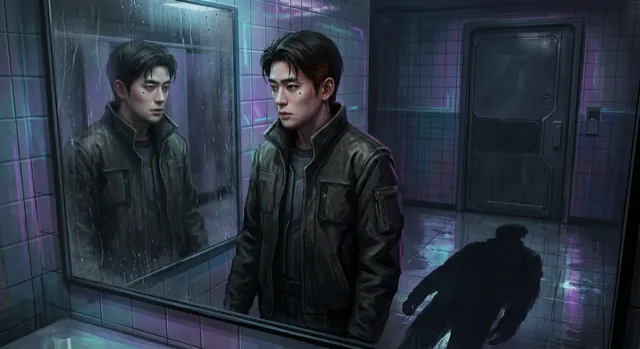
Sua woke. 6:14 in the morning. Sweat beaded on her forehead. The pillow was damp. She was gripping the bedsheet. Clutching it so hard her fingers had gone white. She uncurled them. Sensation came back. Her heart was racing. She looked at the ceiling. Concrete. A crack. She got up and went to the sink. Splashed water on her face. Cold water. She looked in the mirror. Her eyes stared back from the glass. Ordinary eyes. Brown irises. Badly bloodshot. Fine red vessels spread across the whites. The marks of nights without real sleep. She looked at her own eyes. With these eyes she had seen it. In the dream. These eyes had received its gaze.
The morning meeting. The three of them gathered in the observation room. Sua, Gijun, Jina. Papers lay on the desk. The response protocol. And the results of the response-frequency calculation.
"The math is done."
Sua spread out the papers. The coffee had gone cold. No one had touched it. Rows of numbers. Response frequency: 1.42 gigahertz. Modulation pattern: the received signal's inverse phase.
"What does inverse phase mean?"
Jina asked.
"You flip the waveform you received. Positive becomes negative, negative becomes positive. A mirror image."
"Why a mirror image?"
"It's the simplest way to say 'we received you.' You take what they sent, flip it, and send it back, and that's confirmation of receipt. The way a bat fires ultrasound and reads its position from the returning echo. We send back the echo."
Gijun leaned back in his chair. Folded his arms.
"And if we send this, what happens?"
"No idea."
"At 14 billion light-years, a reply would take 14 billion years to arrive."
"And there's no guarantee any reply comes at all."
"Then why send it?"
Sua looked at Gijun.
"Because it's the protocol."
"Can't we just ignore the protocol?"
"It's not that we can't. But if we report this discovery, the International Astronomical Union will tell us to send it."
"And if we don't report it?"
"Then we delete 3 months of observation data and pretend it never happened."
Gijun looked at her.
"That's not something a scientist can do. Erasing data."
"And putting humanity in danger is something a scientist should do?"
Sua didn't answer.
Jina spoke quietly.
"I don't think we should send it."
Sua and Gijun looked at her.
"It's the dreams. The three of us are having the same dream. That means the signal is affecting our brains. If we send a response, the connection could grow stronger."
"Connection?"
"You said it yourself, Sua. That we're receivers. Right now we're only receiving. It's one-way. But if we send a response."
Sua looked at Jina's face. Jina's eyes were trembling. A faint tremor. Fear. Sua felt the same thing rise inside herself.
"If a receiver sends back a response, what does it become?"
Jina said.
"A transceiver."
The observation room went quiet again. The green waveform moved across the monitor. Rising and falling. Regular. Like breathing.
Gijun spoke.
"I don't think we should send it either."
"Why?"
"There's no why. I'm scared. I'm just scared. Last night in the dream, when I saw it. It felt like I was disappearing from myself. Like the me that is me was vanishing."
Sua looked at the monitor. The waveform. A waveform that had crossed the universe for 14 billion years. A waveform that matched human brainwaves by 97.3 percent. What it was, Sua did not know. No one knew. But she knew one thing. As long as this signal existed, the human brain was receiving it. From birth. Every night, every time it sank into REM sleep. Humans were already receivers.
Send a response and it becomes a transceiver. Jina's words rang in Sua's head. Transceiver. Two-way. Did it mean that it was not only watching us, but that it could come in through us.
Sua looked at the papers. The response-frequency results. The numbers. Her hand rested on the papers. Her fingers were trembling. She folded the papers. In half. And in half again.
"Let's not report it."
Sua said. Gijun and Jina looked at her.
"Not the signal, not the brainwave match, not the response calculation. Let's not report any of it."
"Then this discovery."
"Gets buried."
"3 months of work."
"We bury it."
"It's 3 months. That's data for at least one paper."
"There are things more important than a paper."
Gijun looked at Sua. Her eyes. Her eyes did not waver. Gijun nodded. Jina nodded too.
Sua sat down at the computer. She opened the analysis file. 3 months of data. Graphs. Waveforms. Comparison results. She moved the cursor over the delete button. 3 months. Reported to the scientific community, this data was Nobel Prize material. A discovery that would change the history of humankind. Sua knew that. Knowing it, she meant to erase it. Her finger trembled. The index finger on the mouse. One click and it was over. 3 months of work gone. The discovery gone. A discovery that might be the most important in human history.
Sua clicked. A confirmation window appeared. 'This action cannot be undone.' Sua clicked again. The file vanished. The screen went empty. Nothing on the monitor. A black screen.
Sua leaned back in her chair. The light of the monitor was reflecting off her face. Green light. Her back met the backrest. Cold plastic. Sua exhaled. Long. It felt like exhaling 3 months of breath.
But the receiver beside the monitor was still on. A green waveform was moving. Rising and falling. The signal was still coming. Even though Sua had deleted the file, buried the discovery, sent no reply. From 14 billion light-years away, the signal was still coming.
Sua looked at the receiver. The green waveform. Still moving. Rising and falling. Like breathing. Sua laid her hand on the receiver's power button. The button was cold. She didn't press it. Even if she turned the receiver off, another observatory would catch the same signal. In Chile. In Hawaii. In Australia. Even if she buried it, someone would dig it up again. Turn it off. If she turned the receiver off, she wouldn't receive the signal. But Sua's brain was still receiving it. Every night. Each time she fell asleep. Even if she turned the receiver off, Sua's brain didn't turn off.
Night came. Sua lay down on the bed. She closed her eyes. She tried not to fall asleep. If she fell asleep she would dream. In the dream she would see it. And it would see her. Sua opened her eyes. She looked at the ceiling. Concrete. A crack. Sua looked at the pattern of the crack. The crack was branching out. Like tree branches. Like neurons. Like a waveform. Sua felt as if the crack in the ceiling were moving. It wasn't moving. It was concrete. But when she narrowed her eyes, the edges of the crack seemed to tremble faintly. Sua's brain was searching for patterns. Searching for waveforms everywhere. The receiver was tuning to a frequency.
Sua closed her eyes. The headphones were on the desk. She had deleted the signal file. But that sound lingered in Sua's ears. A hum. A low hum. A sound in her memory. A sound that couldn't be deleted. Sleep would come. Sleep couldn't be stopped. REM sleep couldn't be stopped. Sua's brainwaves would align to its frequency. Tonight too. The 97.3 percent would narrow a little further. Every night. Little by little. Sua knew that.
Outside, the wind blew. The wind at 4,200 meters above sea level. Stars were pouring down. The darkness between the stars was looking down. Sua closed her eyes. Even closed, she saw stars. Afterimages left on her retina. The darkness between the afterimages remained too. In that darkness Sua fell asleep. In the moment she fell asleep the corner of Sua's mouth moved faintly. It was not a smile. It was not Sua's muscles that moved. The observatory's clock was passing midnight. The night at 4,200 meters above sea level was still. There was only the sound of the wind and the sound of the receiver's fan. Sua's breathing slowed. Deepened. REM sleep began. Sua's brainwaves were changing. Rising and falling. In the same rhythm as the waveform from 14 billion light-years away.